
Class Design & Programming
Class Design & Programming
Objectives: Structure bungee classes for varied ability levels.
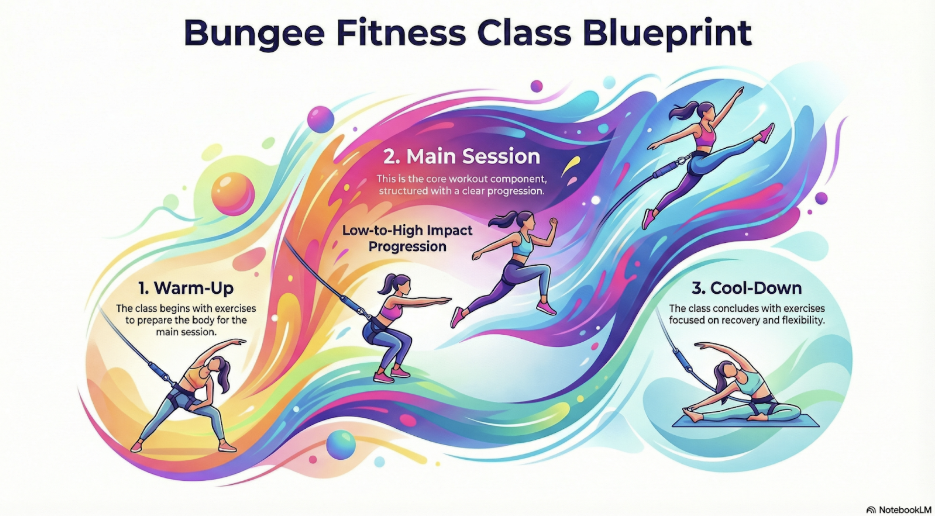
- Warm-up → main session → cool-down
- Class pacing & sequencing
- Low Impact → Higher Impact progressions
- Sample 60-min class plan
How We Format a Bungee Fitness Class Plan
Each WILD Bungee class follows a clear, repeatable structure designed to keep sessions safe, progressive, and easy to deliver, while still allowing space for creativity and individual teaching style.
This format ensures:
- The body is fully prepared before impact or suspension
- Exercises flow whilst keeping up the tempo
- Participants experience balanced strength, cardio, and core work
- Classes finish with effective recovery and regulation
Warm-Up Sequence (8–10 Minutes)
The warm-up is non-negotiable. It prepares the joints, muscles, nervous system, and cardiovascular system for dynamic movement and suspension.
Warm-ups are structured to:
- Mobilise the neck, shoulders, hips, ankles, and spine
- Gradually introduce bungee resistance
- Activate core and glutes
- Rehearse movement patterns that will appear later in the class
Movements progress from grounded mobility → light resistance → controlled jumps, ensuring participants feel confident and supported before intensity increases.
Think: mobilise, activate, rehearse.
Main Sets (Strength, Cardio & Power)
The main body of the class is delivered in short, clear sets, usually pairing 2 exercises per set.
Each set:
- Focuses on a specific movement pattern or energy system
- Allows instructors to cue clearly and correct technique
- Keeps participants engaged without cognitive overload
Sets often alternate between:
- Lower body power (jumps, squats)
- Cardio conditioning (running, burpees)
- Core and stability (press ups, shoulder taps)
- Rotational or transverse movements (wrecking ball, twists)
This structure allows:
- Natural work-to-recovery balance
- Easy regression or progression within each set
- Smooth transitions between exercises
Pairing exercises keeps classes flowing and manageable for both instructor and participants.
Optional Progressions & Variations
Some exercises include optional progressions, such as:
- Adding a torso twist
- Increasing jump height
- Introducing unilateral or rotational load
These are always:
- Optional
- Instructor-led
- Based on participant ability and confidence
Cooldown Sequence (5–7 Minutes)
Cooldowns are essential for nervous system regulation, mobility, and recovery.
Each cooldown includes:
- Gradual reduction of movement intensity
- Gentle stretches for muscles heavily used in class
- Mobility for joints under repeated load
- Breathing to lower heart rate and promote relaxation
Movements are slow, controlled, and often supported by the bungee to allow participants to feel safe, grounded, and calm before leaving the session.
A strong cooldown improves recovery and leaves participants feeling successful, not depleted.
Why This Format Works
This class structure:
- Is easy to repeat and adapt
- Supports beginner to advanced participants
- Allows instructors to focus on cueing and connection
- Reduces injury risk through intelligent sequencing
- Creates consistency across all WILD Bungee classes
Once you understand this framework, you can confidently design your own classes while maintaining the core principles that make bungee fitness safe, effective, and empowering.
Jumps, Squats, Core & Glute Exercises
Focus: Develop strength, power, and endurance in key muscle groups while using the bungee safely.
Example Exercises:
- Squat jumps – soft landings, glutes & quads.
- Split jump lunges – maintain knee alignment, controlled landing, ensure they are controlling the movement to avoid the knee touching the floor.
- Ball Jumps – exhale during exertion, brace transverse abdominis.
- Pencil Jumps – maintain posture, engage core and glutes, land with a good bend through the knees.
Trainer Tips:
- Always monitor joint alignment, especially knees, hips, and ankles.
- Cue engagement of core and glutes on every jump or squat.
Stabilisation & Balance Exercises
Focus: Build core strength, proprioception, and confidence in suspended movements.
Example Exercises:
- Single-leg balance with slight cord support.
- Lateral step-outs
- Trust falls with a push up back to standing
Trainer Tips:
- Encourage slow, controlled movements.
- Focus on engaging deep stabilizers: core, glute medius, spinal muscles.
- Use cueing phrases like: “Stay at resistance, engage your core, soft landing.”
Modifications for Low Impact → High Impact
Purpose: Make exercises accessible while challenging participants appropriately.
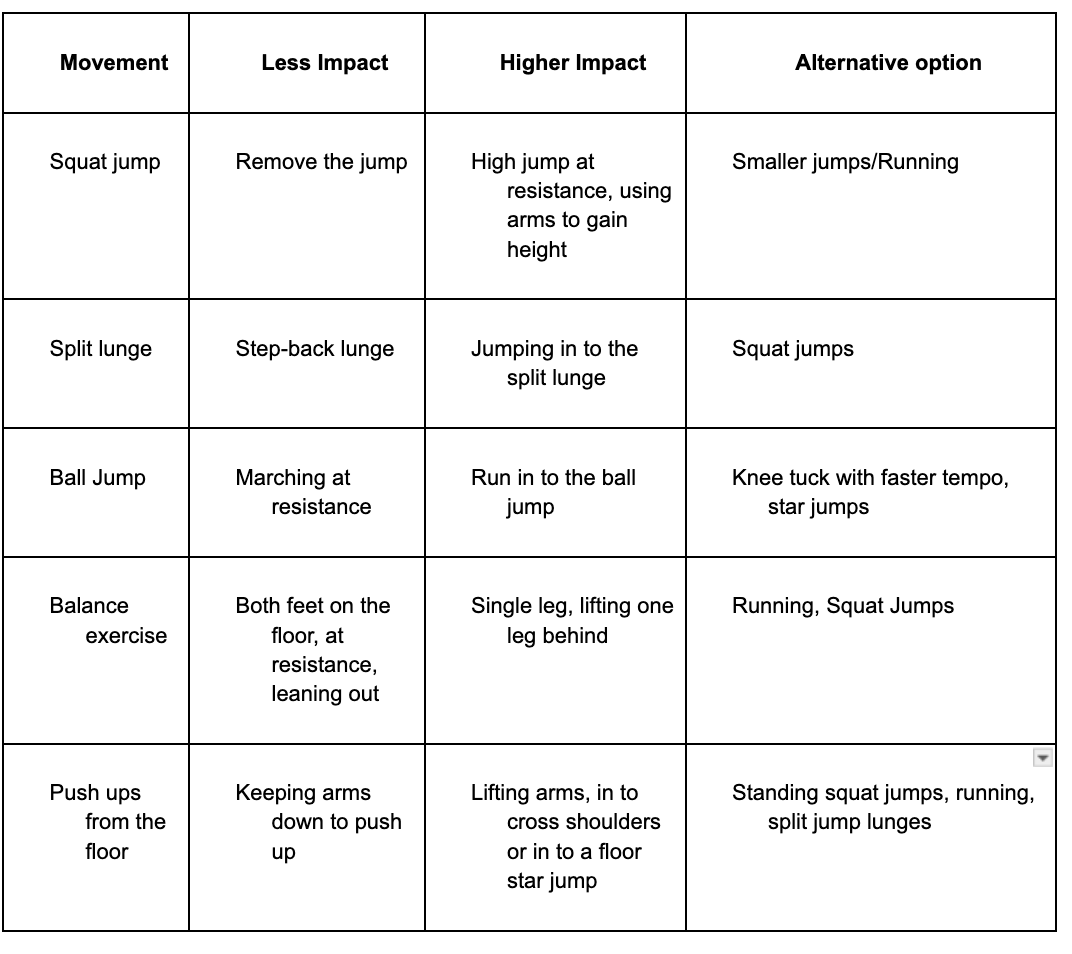
Trainer Tips:
- Always assess participant ability before progression.
- Offer clear cueing and demonstrations at each level.
- Remind participants that quality of movement > number of repetitions.