
📌 Module 1 — Foundations of Hypermobility

📌 Module 1 — Foundations of Hypermobility
Goal: Build a strong scientific and practical understanding of hypermobility as it relates to movement, strength training, aerial and pole fitness.
Module 1 Learning Objectives
By the end of this module, learners will be able to:
- Clearly define hypermobility and related terms
- Distinguish between flexibility, hypermobility, and hyperlaxity
- Understand why certain joints are more vulnerable in aerial and pole work
- Recognise common hypermobility-related conditions
- Identify signs, symptoms, and movement patterns linked to hypermobility
- Understand the role of proprioception and neuromuscular control
- Complete a basic self-screening checklist (non-diagnostic)
1. What Is Hypermobility?
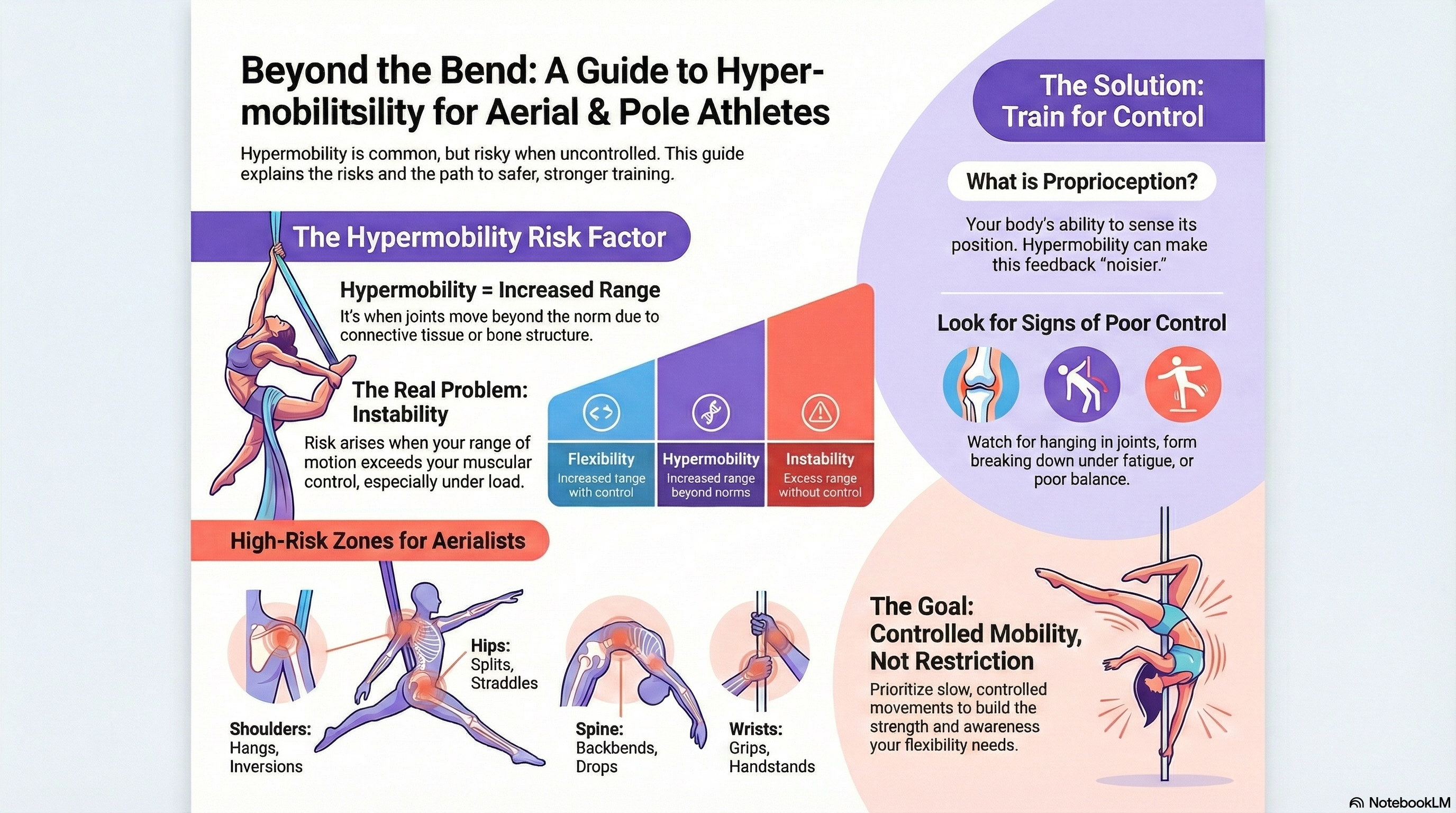
Hypermobility refers to joints that move beyond the normal expected range of motion due to differences in connective tissue structure, neuromuscular control, or both.
Importantly:
- Hypermobility is not inherently bad
- Many aerialists and pole dancers are hypermobile
- Problems arise when range exceeds control
In fitness contexts, hypermobility becomes relevant when:
- Joints repeatedly load at end range
- Strength does not match available mobility
- Proprioception is reduced
- Fatigue leads to loss of control
Key principle:
Hypermobility = increased range
Instability = increased risk
The goal is controlled mobility, not restriction.
2. Types of Hypermobility
Hypermobility is not one single presentation. Understanding why someone is hypermobile helps inform training decisions.
🧬 Genetic Hypermobility
- Present from childhood
- Often runs in families
- Linked to connective tissue differences
- Common in EDS and HSD – EDS (Ehlers-Danlos Syndromes) are rare, inherited connective tissue disorders (like hEDS), while HSD (Hypermobility Spectrum Disorder) is diagnosed for symptomatic hypermobility that doesn’t meet full EDS criteria
🧠 Connective Tissue-Based Hypermobility
- Differences in collagen structure or production
- Ligaments and joint capsules provide less passive stability
- Muscles must compensate more during movement
🦴 Structural Hypermobility
- Influenced by bone shape, joint depth, or alignment
- Example: shallow hip sockets or shoulder joints
- Often unnoticed until higher-load activities (like aerial or pole)
🏃 Functional / Acquired Hypermobility
- Developed through training (dance, gymnastics, yoga, pole)
- Range increases faster than strength
- Common in athletes without underlying connective tissue conditions
In aerial and pole fitness, functional hypermobility layered on top of genetic hypermobility is very common.
3. Flexibility vs Hypermobility vs Hypermobility with Instability
|
Term |
Description |
Risk Level |
|
Flexibility |
Increased range with control |
Low |
|
Hypermobility |
Increased range beyond norms |
Moderate |
|
Hypermobility with instability |
Excess range without control |
High |
Key Distinction
- Flexibility = muscles lengthen
- Hypermobility = joints move further
- Instability = lack of muscular and neurological control
Many aerial and pole injuries occur not because of too much flexibility, but because end-range positions are loaded without sufficient strength or awareness.
4. Joints Commonly Affected (Aerial & Pole Focus)
🦾 Shoulders
- Glenohumeral joint is naturally unstable
- High risk in hangs, inversions, mounts, and dynamic skills
- Common issues: subluxations, impingement, rotator cuff overload
- A subluxation is a partial dislocation, where bones in a joint move out of their normal alignment but remain partially in contact, unlike a full dislocation where they separate completely; it can affect any joint (shoulder, kneecap) causing pain/instability, or refer to a spinal misalignment that interferes with nerves, leading to symptoms like tingling or headaches, often treated by chiropractors.
🦵 Hips
- Deep ranges used in splits, straddles, aerial lines
- Risk of anterior hip instability and labral strain
- Often paired with weak glutes or poor pelvic control
🧍 Spine
- Excessive spinal extension or flexion
- Common in backbends, drops, shapes
- Fatigue can lead to hinging rather than distributed movement
✋ Wrists
- Frequently overlooked
- High load in pole grips, mounts, handstands, floorwork
- Hypermobility here often presents as pain rather than obvious range
5. Common Hypermobility-Related Conditions
Ehlers-Danlos Syndromes (EDS)
A group of genetic connective tissue disorders.
- Hypermobile EDS (hEDS) most relevant in fitness contexts
- Features may include:
- Joint instability
- Chronic pain
- Fatigue
- Poor proprioception
- Diagnosis is medical — coaches do not diagnose
Hypermobility Spectrum Disorders (HSD)
- Individuals with symptomatic hypermobility who do not meet full EDS criteria
- Symptoms can still significantly affect training tolerance
Benign Joint Hypermobility
- Increased joint range without pain or dysfunction
- Can still become problematic under load or fatigue
Important coaching note:
Two people can have the same range of motion and vastly different needs.
6. Signs & Symptoms of Hypermobility
Not all hypermobile individuals experience pain — especially early on.
Common Physical Signs
- Joints that “lock,” “pop,” or feel unstable
- Frequent strains or niggles
- Feeling strong in some areas but weak in others
- Difficulty holding end positions
Neuromuscular & Systemic Signs
- Poor balance or coordination
- Fatigue disproportionate to training load
- Delayed muscle activation
- Difficulty sensing joint position
In aerial and pole, this may look like:
- Hanging into joints instead of engaging muscles
- Losing form under fatigue
- Inconsistent performance day to day
7. Proprioception & Neuromuscular Control
Proprioception is the body’s ability to sense joint position and movement.
In hypermobility:
- Ligaments provide less feedback to the nervous system
- The brain receives “noisier” information
- Muscles may activate too late or inefficiently
This explains why hypermobile athletes may:
- Look strong but feel unstable
- Perform skills well one day and poorly the next
- Struggle more with slow, controlled movements than dynamic ones
Training implication:
Slow, controlled, intentional movement is often harder — and more important — than flexibility or tricks.
📌 Learning Activity: Self-Screening Checklist
(Non-diagnostic, educational use only)
Tick any that apply:
Mobility & Joint Sensation
- ⬜ I can easily move into extreme ranges without stretching
- ⬜ My joints sometimes feel unstable or “loose”
- ⬜ I rely on locking joints to hold positions
Injury & Recovery
- ⬜ I get frequent minor injuries or flare-ups
- ⬜ I feel sore or fatigued longer than expected
- ⬜ Pain moves or changes rather than being consistent
Control & Awareness
- ⬜ Balance is challenging even with good strength
- ⬜ I struggle with slow or controlled movements
- ⬜ My form breaks down quickly when tired
Aerial / Pole-Specific
- ⬜ I hang into shoulders or hips at end range
- ⬜ Wrist or shoulder discomfort appears after classes
- ⬜ I feel strong dynamically but shaky statically
Reflection prompt:
Which areas might benefit most from increased strength, control, or awareness rather than more flexibility?
Module 1 Key Takeaways
- Hypermobility is common and not inherently negative
- Risk increases when range exceeds control
- Aerial and pole place unique demands on already mobile joints
- Proprioception and neuromuscular control are central themes
- Education is the first step to safer, stronger training