
📌 Module 7 — Pole-Specific Adaptations
📌 Module 7 — Mastery, Integration & Individualised Programming
Goal: Enable learners to synthesize all previous modules into personalized, sustainable, and high-performance aerial and pole programming for hypermobile athletes.
Module 7 Learning Objectives
By the end of this module, learners will be able to:
- Develop fully individualized programming for hypermobile aerial and pole athletes
- Integrate strength, stability, mobility, and skill work into cohesive weekly plans
- Implement advanced progression strategies safely
- Monitor performance and adjust programming based on joint control, fatigue, and movement quality
- Reflect and self-assess for continuous improvement
Section 1 — Introduction: Mastery Principles
Overview:
- Mastery comes from consistent application of control, strength, and proprioception principles
- The capstone goal: create a personalized, progressive plan that is safe, effective, and sustainable
- Integrate:
- Skills (splits, inversions, transitions, pole/aerial tricks)
- Strength and stabilization
- Mobility and recovery
- Performance monitoring
Key Concept:
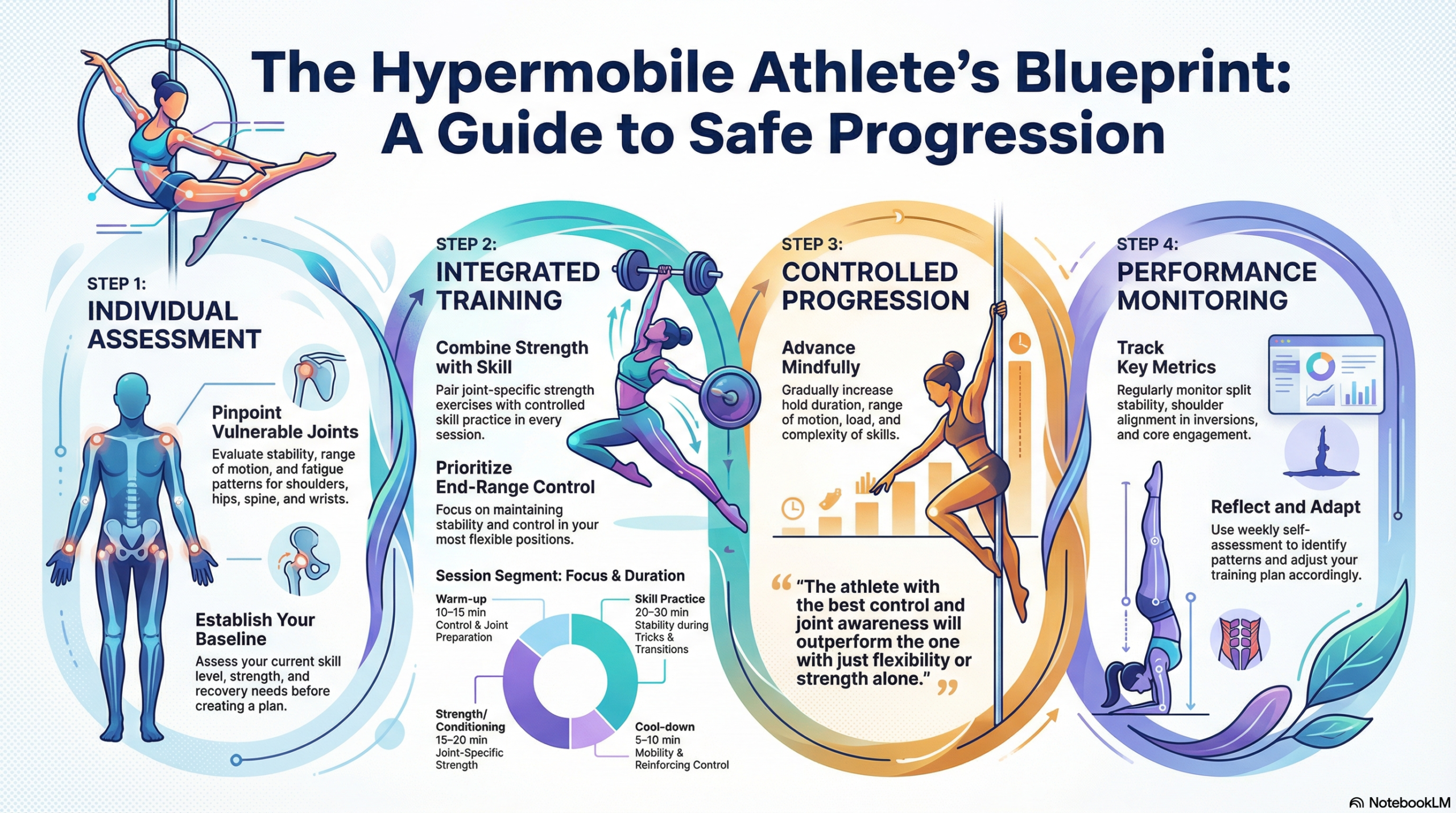
“The athlete with the best control and joint awareness will outperform the one with just flexibility or strength alone.”
Section 2 — Individualized Assessment
Steps:
- Identify vulnerable joints and range-of-motion limits
- Assess current skill level in aerial and pole practice
- Evaluate strength and stability in joint-specific exercises
- Note fatigue patterns and recovery needs
Worksheet Example:
|
Joint |
Current Stability (1–10) |
Current Range (1–10) |
Vulnerabilities |
Notes |
|
Shoulders |
||||
|
Hips |
||||
|
Spine |
||||
|
Wrists |
Section 3 — Integration Strategies
Key Points:
- Pair strength exercises with skill practice at controlled ranges
- Prioritize control in end-range positions
- Progress skill difficulty gradually:
- Controlled holds
- Transitions under control
- Full dynamic skills with stability
- Include recovery and prehab in weekly programming
Sample Integrated Session:
|
Segment |
Duration |
Exercise |
Focus |
|
Warm-up |
10–15 min |
Dynamic mobility & activation |
Control & joint prep |
|
Skill Practice |
20–30 min |
Splits, inversions, pole transitions |
Stability + skill |
|
Strength & Conditioning |
15–20 min |
Glute bridges, scapular push-ups, plank variations |
Joint-specific strength |
|
Cool-down |
5–10 min |
Mobility & recovery |
Reinforce control |
Section 4 — Advanced Progression & Programming
Progression Principles:
- Gradually increase:
- Hold duration
- Range of motion
- Load/resistance
- Complexity of transitions
- Monitor:
- Joint control
- Movement quality
- Fatigue levels
- Adjust programming weekly based on performance metrics and self-assessment
Example 4-Week Progression for Splits & Inversions:
|
Week |
Skill Focus |
Strength Focus |
Notes |
|
1 |
Controlled end-range holds |
Glute bridges, scapular holds |
Low-load, focus on control |
|
2 |
Split transitions & slow inversions |
Core + shoulder stability |
Increase duration |
|
3 |
Inversions with small dynamic movements |
Unilateral leg/glute work |
Moderate load |
|
4 |
Full transitions with choreography |
Combined joint-focused exercises |
Monitor fatigue |
Section 5 — Performance Monitoring & Reflection
Key Metrics:
- Split stability & smoothness
- Shoulder and scapular alignment in inversions
- Core engagement & spine alignment
- Joint-specific fatigue rating
Reflection Prompts:
- Which exercises improve control most?
- Are there patterns in fatigue or instability?
- How will you adapt your weekly plan?
- Which recovery strategies enhance performance?