
📌 Module 3 — Assessment Essentials
📌 Module 3 — Safe Strength & Conditioning for Hypermobility
Goal: Learn how to safely strengthen and condition hypermobile joints for aerial and pole fitness.
Module 3 Learning Objectives
By the end of this module, learners will be able to:
- Understand why traditional strength training may need adaptation for hypermobile joints
- Identify exercises that promote dynamic stability
- Apply progressive loading principles safely
- Incorporate proprioception and neuromuscular control drills
- Create a joint-specific training plan for aerial and pole practice
Section 1 — Principles of Strength Training for Hypermobile Joints
Key Concepts
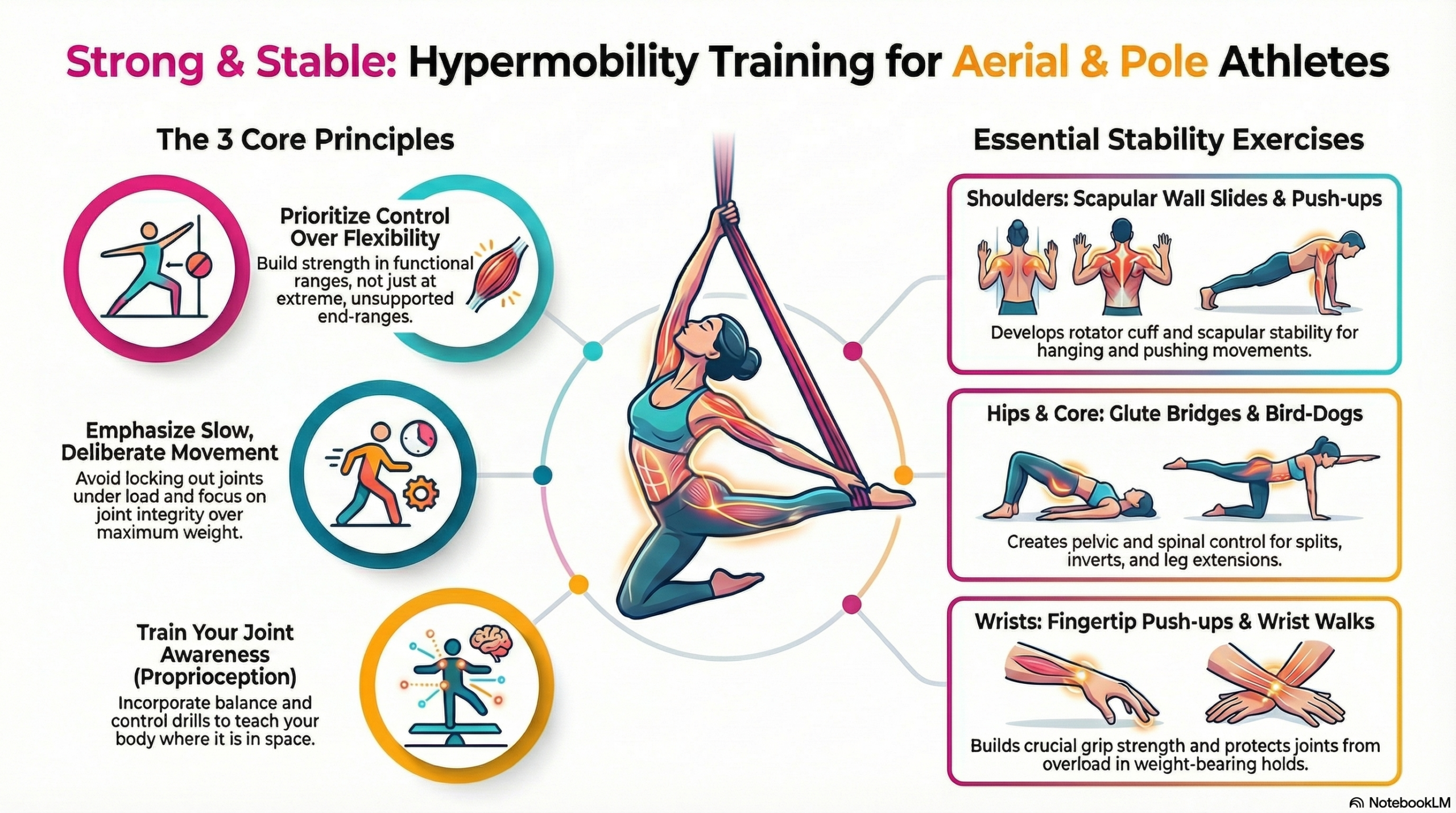
- Hypermobile joints often appear strong but may lack control at end range
- Key goals:
- Build strength at functional ranges
- Improve proprioception
- Prevent joint hyperextension under load
Adaptations
- Avoid locked-out positions at end-range until control is sufficient
- Emphasize slow, controlled movements
- Prioritize joint integrity over maximum load
Section 2 — Muscle Activation & Stabilization
Aerial & Pole Focus
- Shoulders: rotator cuff + scapular stabilizers
- Hips: glutes, hip rotators, and core
- Spine: multifidus, obliques, deep core muscles
- Wrists: forearm flexors/extensors, grip stability
Drills
- Scapular push-ups / wall slides for shoulder stability
- Glute bridges with slow holds for hip and pelvic control
- Bird-dogs and plank variations for core stabilization
- Wrist walks / fingertip push-ups for grip and wrist strength
Section 3 — Proprioception & Neuromuscular Control Drills
Key Concepts
- Proprioception deficits increase injury risk
- Training should challenge balance, joint awareness, and controlled motion
Exercises
- Slow transitions into split, straddle, or inverted positions
- Eyes-closed holds for joint awareness
- Use of unstable surfaces (soft mat, balance pad) for controlled balance work
- Repetition under fatigue to improve neuromuscular control
Section 4 — Joint-Specific Training Guidelines
|
Joint |
Focus |
Recommended Exercises |
Notes |
|
Shoulders |
End-range stability |
Scapular wall slides, band pull-aparts, isometric holds |
Avoid locked elbows under load initially |
|
Hips |
Hip and pelvic control |
Glute bridges, clamshells, slow leg lifts |
Emphasize glute activation at full split |
|
Spine |
Core stabilization |
Bird-dogs, planks, back extensions |
Avoid hyperextension under fatigue |
|
Wrists |
Grip & joint integrity |
Fingertip push-ups, wrist walks |
Avoid extended wrist overload early |
Section 5 — Programming for Safety & Progression
Principles
- Begin with low-load, high-control exercises
- Progress by increasing range, time under tension, or load gradually
- Track fatigue, joint stress, and control breakdown
- Combine strength + mobility + proprioception in each session
Example Weekly Microcycle (Aerial/Pole Focus)
|
Day |
Focus |
Exercises |
Notes |
|
Mon |
Shoulder & Core |
Wall slides, plank variations, scapula holds |
Low-load, controlled |
|
Wed |
Hips & Legs |
Glute bridges, clamshells, controlled leg lifts |
End-range control |
|
Fri |
Full Body Integration |
Inverted holds, slow splits transitions |
Combine mobility + strength |
Section 6 — Reflection & Self-Assessment
- Which joints feel unstable during aerial/pole movements?
- Which exercises improve control or reduce wobble?
- How does fatigue impact your control at end-range?