
📌 Module — Case Studies & Practical Examples

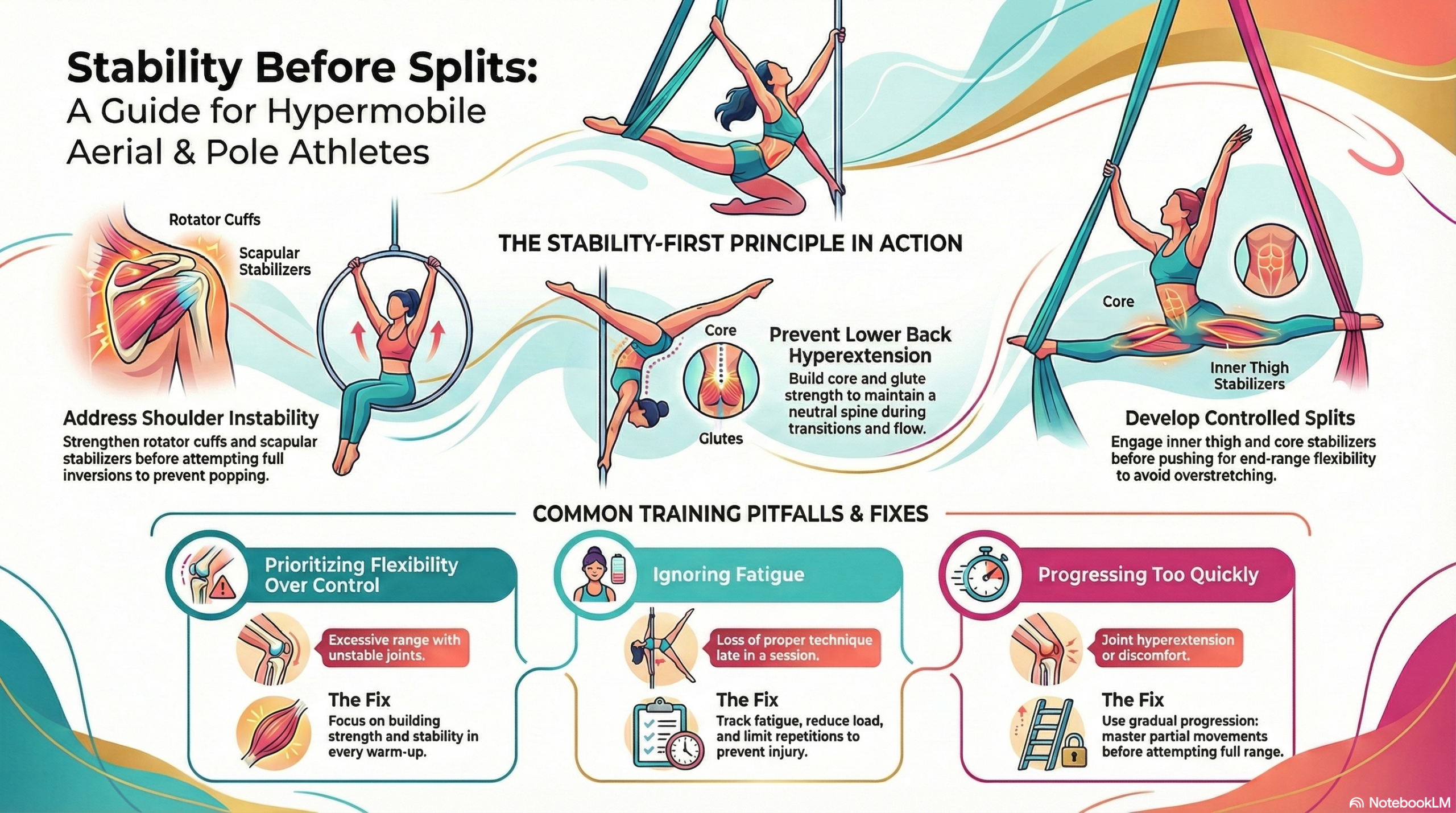
📌 Module — Case Studies & Practical Examples in Hypermobile Aerial & Pole Fitness
Goal: Demonstrate applied strategies, highlight common mistakes, and show progression timelines for skill and strength gains in hypermobile students.
Module Learning Objectives
By the end of this module, learners will be able to:
- Analyze real-world hypermobile student examples and identify risk factors
- Apply assessment results to modify programs safely
- Recognize common mistakes and implement corrections
- Understand progression timelines for skill acquisition and strength development
- Translate theory into actionable strategies for teaching and training
Section 1 — Case Study 1: Shoulder Instability in Aerial Hoop
Scenario:
- Student: 18-year-old beginner aerialist
- Presenting Issue: Frequent shoulder popping during inversions, reduced endurance
- Assessment: Shoulder hypermobility, weak rotator cuff, reduced scapular control
Intervention:
- Strengthened rotator cuff and scapular stabilizers
- Introduced partial inversions and control-focused drills
- Monitored fatigue and limited consecutive inversion attempts
Outcome:
- Within 6 weeks: improved shoulder stability, controlled inversions, reduced popping
- Demonstrates: importance of assessment-driven modifications
Key Takeaway:
Always address stability before range, even for visually flexible students.
Section 2 — Case Study 2: Lower Back Hyperextension in Pole Fitness
Scenario:
- Student: 24-year-old intermediate pole dancer
- Presenting Issue: Excessive lumbar arch during transitions, minor discomfort after sessions
- Assessment: Hypermobile lumbar spine, weak core and glutes
Intervention:
- Core stabilization exercises: planks, dead bugs, glute bridges
- Taught controlled transitions with neutral spine
- Progressed from partial moves → full flow sequences
Outcome:
- Reduced discomfort and improved control
- Strength gains enabled more advanced tricks without pain
- Shows: progression and corrective exercises prevent overuse injuries
Section 3 — Case Study 3: Hip & Split Control in Aerial & Floor Work
Scenario:
- Student: 15-year-old teen in aerial silks and pole
- Presenting Issue: Extreme flexibility but poor control in splits; risk of overstretching
- Assessment: Hip hypermobility, weak inner thigh stabilizers
Intervention:
- Stability-focused split drills, engaging adductors and core
- Limited end-range practice until control improved
- Gradually increased range once stability maintained
Outcome:
- After 8 weeks: student achieved controlled splits without hyperextension
- Demonstrates: slow, progressive, and controlled skill acquisition is safer for hypermobile joints
Section 4 — Common Mistakes & Corrections
|
Mistake |
How it Shows |
Correction |
Notes |
|
Prioritizing flexibility over control |
Excessive range, unstable joints |
Focus on strength and stability first |
Reinforce in every warm-up |
|
Ignoring fatigue signs |
Loss of technique late in class |
Track fatigue, reduce load |
Prevents injury |
|
Skipping prehab exercises |
Joint instability, pain |
Include daily prehab and activation |
Essential for hypermobile athletes |
|
Progressing too quickly |
Hyperextension, discomfort |
Gradual progression with monitoring |
Use partial → controlled → full range |
Section 5 — Progression Timelines
Example Timeline for Hypermobile Student in Pole/Aerial:
|
Week |
Focus |
Skill/Strength Target |
Notes |
|
1–2 |
Assessment & Prehab |
Identify weak joints, introduce stability exercises |
Partial range only |
|
3–4 |
Controlled Skill Practice |
Partial inversions, transitions, controlled splits |
Monitor fatigue |
|
5–6 |
Integrated Strength |
Add core, shoulder, hip, and glute strengthening |
Controlled progression |
|
7–8 |
Full Skill Flow |
Combine sequences, maintain control under fatigue |
Assess readiness for full range |
|
9+ |
Maintenance & Refinement |
Refine flow, increase complexity, maintain strength |
Long-term strategy |