
Course Vision & Who It’s For
Mobility, Stability & Strength: Safe Training with Hypermobility for Aerial & Pole Fitness
Course Vision & Who It’s For
This course empowers fitness professionals, coaches, and movement enthusiasts with the knowledge and tools to train individuals with hypermobility safely and effectively, especially in aerial and pole fitness contexts.
📌 Ideal for:
- Aerial/pole instructors
- Personal trainers
- Students and self-coached movers with hypermobility
Overall Learning Outcomes
By the end of this course, learners will be able to:
✔ Understand hypermobility (including hEDS/HSD) from a clinical and functional perspective
✔ Tailor training for hypermobile clients
✔ Apply principles of safe strength, stability, and movement mechanics
✔ Integrate hypermobility-focused modifications into aerial and pole skills
✔ Design programs that reduce injury risk and improve control
Course Structure & Modules
📌 Module 1 — Foundations of Hypermobility
Goal: Build a scientific base.
Topics Covered
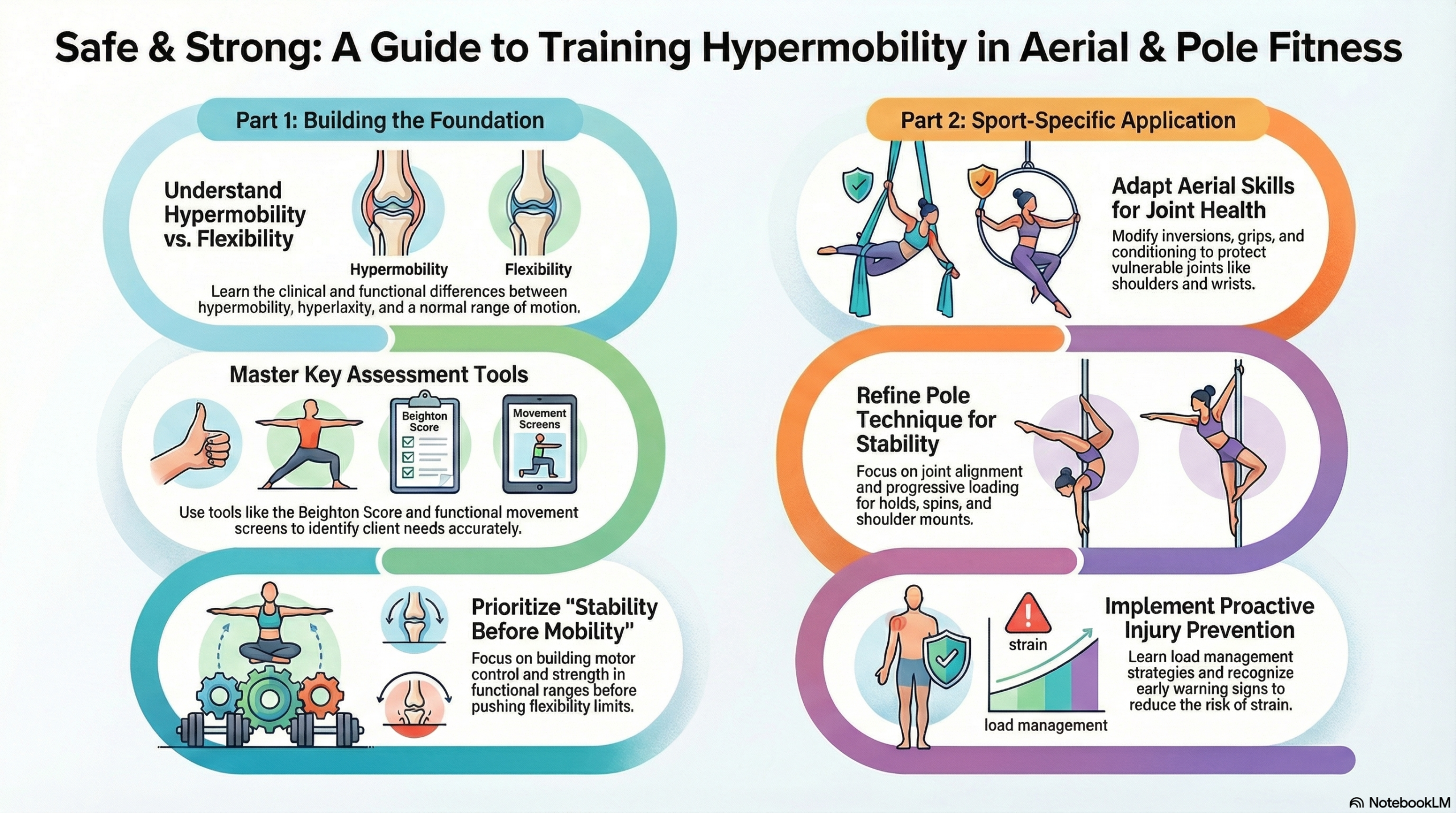
- What is hypermobility?
- Genetic, connective tissue, structural, functional
- Distinguishing normal flexibility vs hypermobility vs hyperlaxity
- Joint types commonly affected (shoulders, hips, spine, wrists)
- Common conditions: EDS, HSD, benign hypermobility
- Signs & symptoms
- Proprioception & neuromuscular factors
Learning Activities
📌 Self-screening checklists
📌 Module 2 — Anatomy & Biomechanics
Goal: Understand how connective tissues and joints behave differently.
Topics Covered
- Collagen & connective tissue basics
- Joint capsules, ligaments, tendons
- Muscle-joint interaction
- Proprioception breakdown in hypermobility
- Why hypermobility becomes instability
Practical Tools
✔ Joint mobility vs joint stability chart
✔ Movement quality calculators
📌 Module 3 — Assessment Essentials
Goal: Teach reliable screening tools.
Topics Covered
- Beighton Score & limitations
- Upper & lower body mobility screens
- Functional movement assessments
- Stability vs mobility testing
- Postural analysis specific to aerial/pole demands
Practical Tools
📌 Printable assessment forms
📌 Video tutorials for live and online assessments
📌 Module 4 — Programming Principles for Hypermobility
Goal: Fundamentals before skill practice.
Core Concepts
✔ Stability before mobility
✔ Motor control & proprioception first
✔ Strength in functional ranges
✔ Progressive overload with caution
✔ Pain vs discomfort differentiation
Program Templates
💡 Beginner — Intro stability
💡 Intermediate — Strength & coordination
💡 Advanced — Power & aerial prep
📌 Module 5 — Strength & Control for Hypermobility
Goal: Build strength that protects joints.
Key Training Areas
- Core & lumbo-pelvic control
- Scapular stability
- Rotator cuff & shoulder control
- Hip control & glute activation
- Wrist and grip conditioning
Drills & Exercises
✔ Low-load isometrics
✔ Slow tempo eccentrics
✔ Closed-chain control work
✔ Proprioceptive balance progressions
✔ Resistance band progressions
📌 Module 6 — Aerial-Specific Adaptations
Goal: Translate strength/stability into aerial work.
Topics Covered
- Safe entry into aerial conditioning
- Hook grips & wrist load considerations
- Inversions with hypermobility
- Shoulder health strategies
- Strength prerequisites for aerial elements
Progressions
🟢 Beginner: Skin the Cat prep
🔵 Intermediate: Inversion control drills
🟣 Advanced: Dynamic aerial combos
📌 Module 7 — Pole-Specific Adaptations
Goal: Build safe pole practice pathways.
Topics Covered
- Handling load on internal rotations
- Joint alignment under bodyweight
- Progressions for locks, holds, spins
- Pressure management on wrists & shoulders
Skill Progressions Example
📍 Pole Sit → Side-Sit → Gemini variations
📍 Shoulder mounts (prep → half turn → full)
📌 Module 8 — Injury Prevention & Management
Goal: Reduce risk and handle flare-ups.
Topics Covered
- Early warning signs of strain
- Overuse vs acute injuries
- Load management strategies
- Integrating recovery (sleep, nutrition, rest days)
- Pain monitoring tools (VAS scale, movement diaries)
Supplemental Tools
📌 Pre-hab exercise library
📌 Warm-up and cool-down protocols
📌 Module 9 — Coaching & Communication
Goal: Practical coaching skills.
Topics Covered
- Sensitive coaching language
- Explaining body mechanics to clients
- Modifying cues for pain vs form
- Remote coaching adaptations
- Documentation & tracking
Resources
✔ Client feedback forms
✔ Progression logs
📌 Module 10 — Capstone Project
Goal: Apply knowledge.
🎯 Create a periodized program for a hypothetical client with:
- Hypermobility diagnosis
- Goals in aerial and/or pole capacity
- Assessment data
Includes:
✔ Rationale write-up
✔ Progressions week-by-week
✔ Safety considerations
Course Materials & Support
Included:
- PDF manuals
- Printable worksheets
- Templates for client plans
- Quizzes & certificates
Assessment & Certification
✔ Module quizzes
→ Receive Certificate of Completion
Optional Add-Ons
🎧 Audio mini-lectures
📘 Client handouts you can share with students