
📌 Module 8 — Injury Prevention & Management

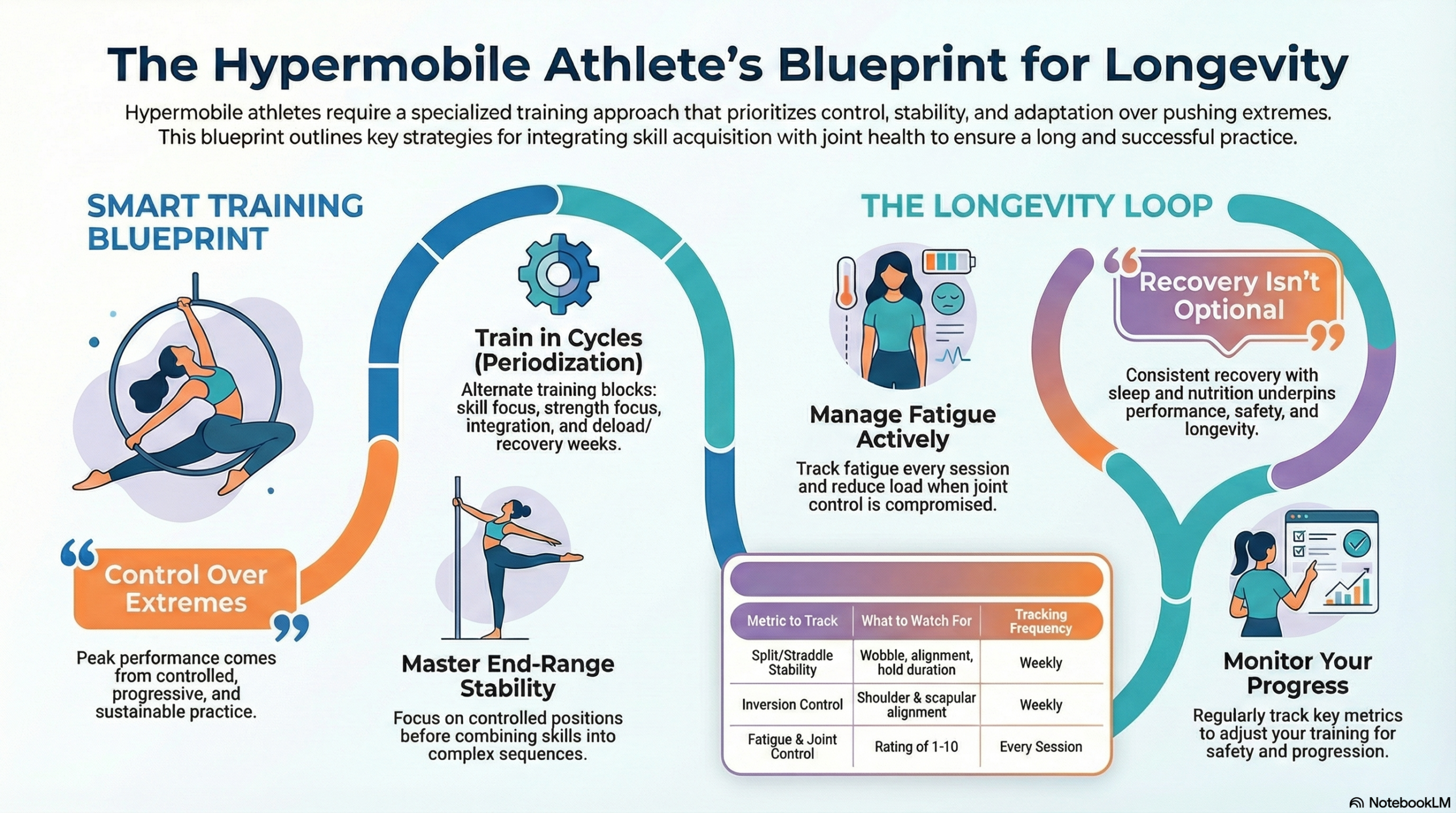
📌 Module 8 — Mastery, Performance Optimization & Long-Term Maintenance
Goal: Equip learners to maintain peak performance safely, optimize programming, and ensure long-term joint health and skill retention.
Module 8 Learning Objectives
By the end of this module, learners will be able to:
- Integrate all previous knowledge into a long-term, sustainable program
- Apply advanced performance optimization strategies for aerial and pole skills
- Identify strategies for preventing plateaus and maintaining gains
- Track performance metrics and adjust training for safety and progression
- Develop a lifetime plan for healthy, hypermobile aerial/pole practice
Section 1 — Introduction to Long-Term Performance Optimization
Overview:
- Hypermobile athletes require consistent monitoring, progression, and adaptation
- Goals: maximize skill acquisition, strength, and stability while minimizing injury risk
- Integrate:
- Advanced skill sequencing
- Strength & stabilization
- Fatigue management
- Recovery and prehab
Key Concept:
“Peak performance comes from controlled, progressive, and sustainable practice, not from pushing extremes.”
Section 2 — Advanced Programming Strategies
Key Strategies:
- Periodization for Hypermobile Athletes:
- Divide training into blocks: skill focus, strength focus, mixed integration, and deload/recovery weeks
- Skill Progression:
- Focus on controlled end-range positions, smooth transitions, and choreography
- Combine skills in complex sequences once stability is consistent
- Strength & Conditioning Maintenance:
- Maintain joint-specific exercises for shoulders, hips, spine, wrists
- Include rotational, unilateral, and dynamic exercises to enhance stability
Section 3 — Fatigue & Overload Management
- Hypermobile joints are highly susceptible to fatigue-induced instability
- Strategies:
- Track fatigue with daily/session logs
- Reduce load when control is compromised
- Include planned deload weeks every 4–6 weeks
- Prioritize quality over quantity in skill practice
Section 4 — Recovery & Longevity
Long-Term Recovery Principles:
- Active recovery: mobility flows, gentle inversions, slow transitions
- Passive recovery: rest, self-massage, stretching
- Sleep, nutrition, hydration: support connective tissue and repair
- Regular reassessment: joint control, strength, and mobility
Tip:
“Recovery isn’t optional. Consistent recovery underpins performance, safety, and longevity.”
Section 5 — Self-Monitoring & Performance Metrics
Metrics to Track:
|
Metric |
Description |
Tracking Frequency |
|
Split/straddle stability |
Wobble, alignment, hold duration |
Weekly |
|
Inversion control |
Shoulder and scapular alignment |
Weekly |
|
Transition fluidity |
Smoothness & timing of movements |
Weekly |
|
Fatigue & joint control |
Rating 1–10 |
Every session |
Reflection:
- Which exercises improve stability most?
- Are certain skills consistently affected by fatigue?
- How will you adjust long-term programming to sustain performance?