
📌 Module 2 — Anatomy & Biomechanics

📌 Module 2 — Anatomy & Biomechanics
Goal: Understand how connective tissues and joints behave differently, and how this affects hypermobility in aerial and pole fitness.
Module 2 Learning Objectives
By the end of this module, learners will be able to:
- Explain the role of collagen and connective tissue in joint stability
- Identify key joint structures: capsules, ligaments, tendons
- Understand how muscles interact with hypermobile joints
- Recognise how proprioception is impacted by hypermobility
- Explain why hypermobility often leads to instability under load
- Use tools to assess mobility vs stability and evaluate movement quality
Section 1 — Collagen & Connective Tissue Basics
Overview
- Collagen is the main structural protein in ligaments, tendons, and joint capsules.
- It determines joint elasticity, stiffness, and passive stability.
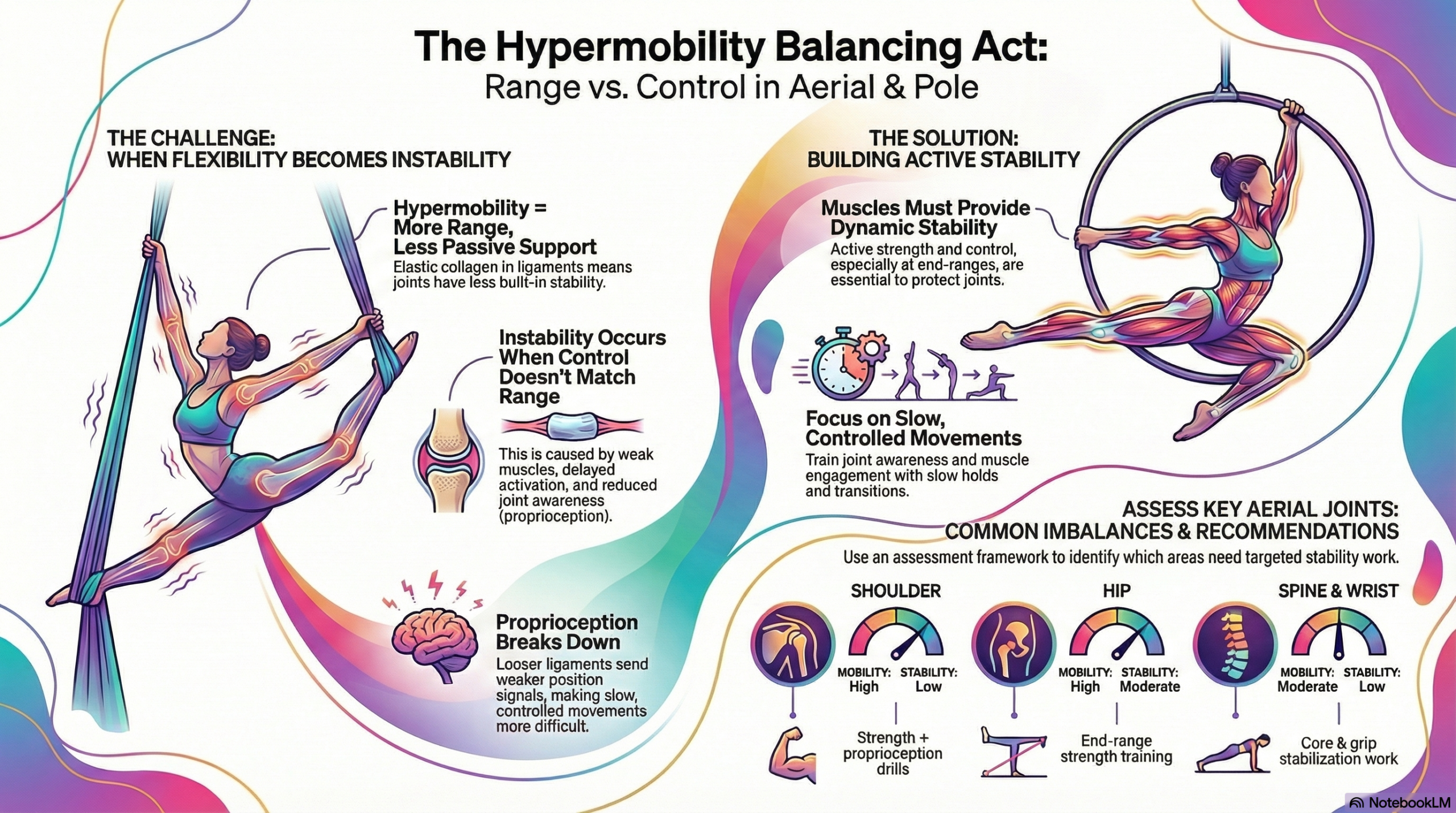
- In hypermobility, collagen may be more elastic, allowing greater range but reducing passive support.
Aerial & Pole Context
- Hypermobile athletes may achieve extreme ranges in splits, shoulder positions, and inversions.
- The joint is less passively stable, meaning muscles must control these ranges actively.
Practical Tip
- Strength and neuromuscular control are essential to compensate for elastic connective tissues.
Section 2 — Joint Capsules, Ligaments, & Tendons
Key Structures
- Joint Capsules: Enclose and stabilize the joint passively.
- Ligaments: Connect bone to bone; limit excessive motion.
- Tendons: Connect muscles to bones; transmit force for movement.
Hypermobile Considerations
- Elastic capsules/ligaments = greater range, reduced passive stability
- Muscles must provide dynamic stability, especially in loaded aerial/pole positions
Aerial & Pole Application
- Shoulders: hangs, inversions, dynamic transitions
- Hips: splits, straddles, aerial lines
- Wrists: handstands, floorwork, pole grips
Section 3 — Muscle-Joint Interaction
Overview
- Muscles are the primary stabilizers for hypermobile joints
- Dynamic stability depends on:
- Muscle strength
- Activation timing
- End-range control
Key Points
- Delayed activation increases risk of instability
- Strength in end-range positions is crucial for aerial and pole skills
Example
- Shoulder inversion: rotator cuff and scapular muscles must stabilize to protect hypermobile ligaments
Section 4 — Proprioception Breakdown in Hypermobility
Overview
- Proprioception = body’s ability to sense joint position and movement
- In hypermobility:
- Ligaments are looser → weaker sensory signals
- Delayed or inefficient muscle activation occurs
Implications
- End-range positions may feel unstable
- Slow, controlled movements are harder than dynamic ones
- Risk of joint collapse or injury increases with fatigue
Practical Drill
- Slow controlled transitions between split, straddle, and straight-leg lifts
- Focus on joint awareness and muscle engagement
Section 5 — Why Hypermobility Becomes Instability
Concept
- Hypermobility = increased range
- Instability = control does not match range
Factors Leading to Instability
- Elastic connective tissue
- Weak or delayed muscular response
- Reduced proprioception
- Fatigue or high-load positions
Aerial/Pole Example
- Collapsing shoulder in a hanging inversion
- Difficulty holding split or straddle shapes
- Joint “popping” during transitions
Section 6 — Practical Tools
1. Joint Mobility vs Stability Chart
| Joint | Mobility | Stability | Recommendation |
| Shoulder | High | Low | Strength + proprioception |
| Hip | High | Moderate | Strength in end-range |
| Spine | Moderate | Low | Core stabilization drills |
| Wrist | Moderate | Low | Grip & wrist stability work |
2. Movement Quality Calculator
How to use:
- Observe joint control, alignment, timing, and fatigue response
- Rate movement: Excellent / Moderate / Needs Improvement
- Identify weak areas for strength or proprioception exercises
Example:
- Shoulder inversion: wobble = Needs Improvement → add rotator cuff + scapula drills
- Split hold: collapse at end-range → add glute/hip control work
Section 7 — Reflection & Learning Activities
- Observation Exercise:
- Watch your aerial or pole practice or a student’s practice
- Identify which joints may have mobility exceeding stability
- Note exercises or skills that could be modified
- Practical Application:
- Perform slow end-range holds in split, straddle, or shoulder hang
- Focus on activating stabilizing muscles before moving
- Self-Assessment:
- Use the Joint Mobility vs Stability chart to map your own or a client’s joints
- Use the Movement Quality Calculator to assess control
🔍 Self-Assessment Tools
(Hypermobility • Aerial & Pole Fitness)
1️⃣ Joint Mobility vs Stability Self-Assessment Chart
Purpose
To help identify where a joint has plenty of range but lacks control, which is one of the biggest injury risk factors for hypermobile aerial and pole students.
This tool shifts the focus from “How flexible am I?” to
👉 “How well can I control the range I already have?”
How to Use (Instructions for Learners)
-
Assess each joint individually
-
Base your answers on:
-
How the joint behaves under load
-
How it feels during slow, controlled movement
-
How it behaves when fatigued
-
-
Be honest — this is about safety, not ability
Joint Mobility vs Stability Chart
For each joint, circle or mark the most accurate description.
| Joint | Mobility (Range) | Stability (Control) | Notes |
|---|---|---|---|
| Shoulders | ⬜ Limited ⬜ Normal ⬜ High |
⬜ Poor ⬜ Moderate ⬜ Strong |
|
| Elbows | ⬜ Limited ⬜ Normal ⬜ High |
⬜ Poor ⬜ Moderate ⬜ Strong |
|
| Wrists | ⬜ Limited ⬜ Normal ⬜ High |
⬜ Poor ⬜ Moderate ⬜ Strong |
|
| Hips | ⬜ Limited ⬜ Normal ⬜ High |
⬜ Poor ⬜ Moderate ⬜ Strong |
|
| Knees | ⬜ Limited ⬜ Normal ⬜ High |
⬜ Poor ⬜ Moderate ⬜ Strong |
|
| Spine | ⬜ Limited ⬜ Normal ⬜ High |
⬜ Poor ⬜ Moderate ⬜ Strong |
Interpreting Results
-
High mobility + poor stability
→ 🚨 High risk joint
Focus on:-
Isometrics
-
Slow tempo strength
-
Reduced end-range loading
-
-
High mobility + moderate stability
→ ⚠️ Trainable but cautious
Focus on:-
Controlled range
-
Reduced volume
-
Fatigue monitoring
-
-
Normal mobility + strong stability
→ ✅ Lower risk joint
Can tolerate:-
Skill progressions
-
Load increases (gradually)
-
Reflection Prompt (Workbook)
Which joints show high mobility but lower stability?
How might this change your training choices or teaching cues?
2️⃣ Movement Quality Calculator (Control Assessment)
Purpose
To assess how well someone controls movement, not just whether they can complete it.
This is especially important for hypermobile bodies, where a movement can look impressive but lack stability.
How to Use
Choose 1–3 key movements relevant to aerial or pole work (examples below).
Examples:
-
Invert preparation
-
Dead hang shoulder engagement
-
Pole sit entry
-
Controlled descent from aerial skill
-
Plank or hollow body hold
Score each movement using the calculator.
Movement Quality Scoring System
For each movement, score 1–5 in each category.
1️⃣ Control
-
1 = Joint collapses or shakes excessively
-
3 = Some control but inconsistent
-
5 = Smooth, controlled throughout
2️⃣ Alignment
-
1 = Poor alignment, joints lock or hyperextend
-
3 = Mostly aligned with corrections needed
-
5 = Strong alignment maintained
3️⃣ Tempo Awareness
-
1 = Fast, uncontrolled, “dumping” into positions
-
3 = Some slowing but inconsistent
-
5 = Fully controlled tempo
4️⃣ Proprioception (Body Awareness)
-
1 = Unable to feel joint position
-
3 = Awareness improves with cues
-
5 = Strong internal awareness without cues
Movement Quality Calculator Table
| Movement | Control (1–5) | Alignment (1–5) | Tempo (1–5) | Proprioception (1–5) | Total (20 max) |
|---|---|---|---|---|---|
Scoring Interpretation
-
0–10 → 🚨 High risk
-
Focus on regression
-
Floor-based prep
-
Isometric strength
-
-
11–15 → ⚠️ Developing control
-
Reduce speed
-
Limit fatigue
-
Partial ranges only
-
-
16–20 → ✅ Good movement quality
-
Suitable for progression
-
Monitor fatigue closely
-
Key Rule for Hypermobile Athletes
A movement is only “ready” when it can be controlled slowly, under fatigue, and repeatedly — not just once.
Reflection Prompts (Workbook)
-
Which movements scored lowest?
-
What joint was most difficult to control?
-
How would you modify this movement next session?
-
What strength or stability work is needed before progressing?