
📌 Module 4 — Programming Principles for Hypermobility
📌 Module 4 — Programming Aerial & Pole Work for Hypermobility
Goal: Integrate hypermobility knowledge, anatomy, and strength principles into safe and effective aerial and pole programming.
Module 4 Learning Objectives
By the end of this module, learners will be able to:
- Plan aerial/pole sessions that balance mobility, stability, strength, and proprioception
- Apply progressive, controlled programming for hypermobile joints
- Adapt exercises and skills based on joint control and fatigue
- Create joint-specific training plans for safe aerial and pole practice
- Monitor movement quality and adjust programming as needed
Section 1 — Introduction to Programming for Hypermobile Athletes
Overview:
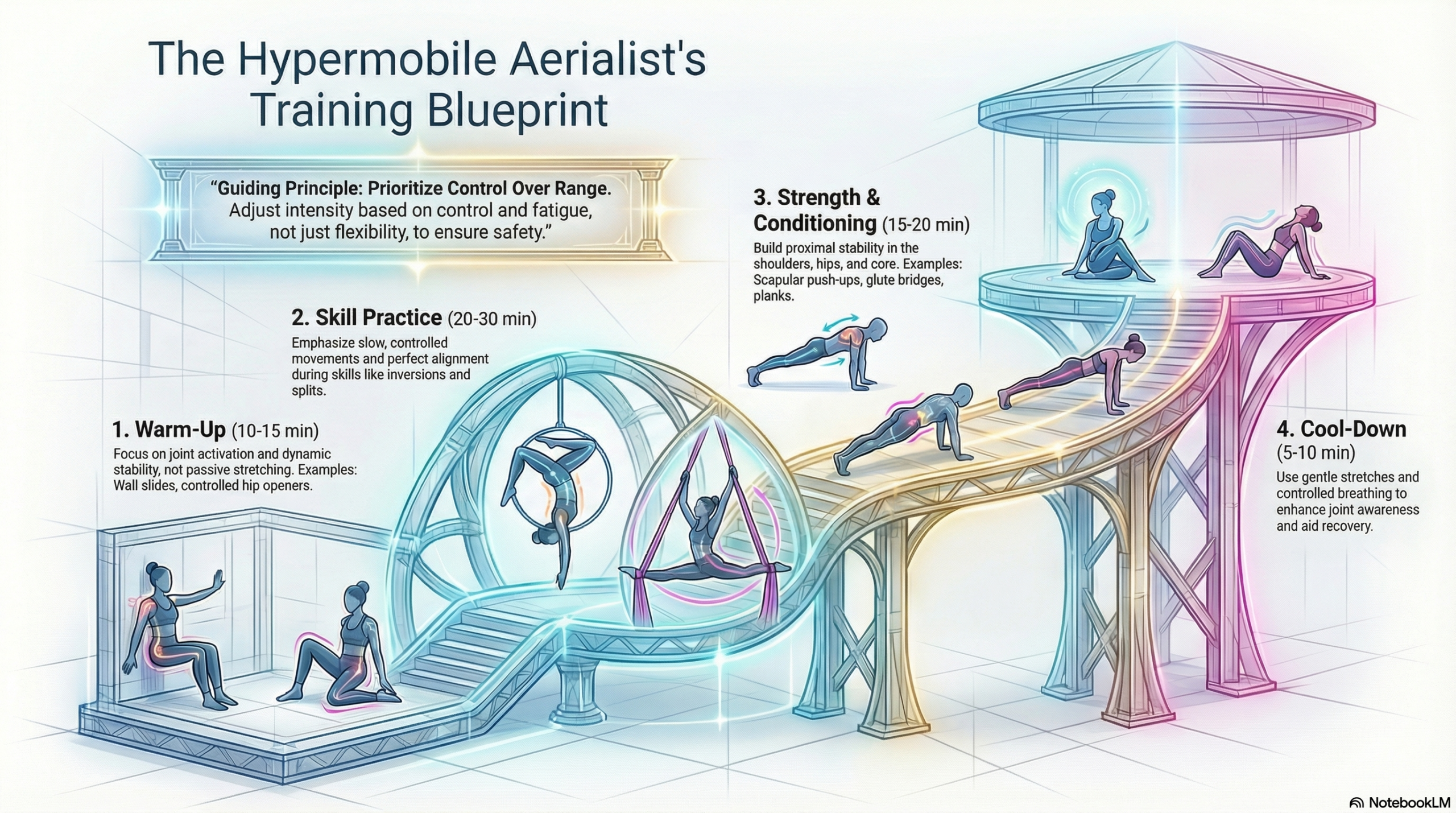
- Hypermobile athletes need programming that prioritizes control over range
- Sessions should integrate:
- Warm-up (joint activation and dynamic stability)
- Skill practice (controlled end-range movements)
- Strength and stabilization work
- Cool-down (mobility and recovery)
Aerial/Pole Context:
- Splits, straddles, inversions, shoulder hangs, and pole spins all require joint stability under load
- Programming should match strength, control, and proprioception to the demands of these skills
Section 2 — Structuring a Session
Typical Session Structure:
- Warm-up (10–15 min):
- Shoulder wall slides, scapular activation
- Hip openers, controlled split transitions
- Wrist and spine mobility drills
- Skill Practice (20–30 min):
- Slow split or straddle transitions
- Inversions and holds with controlled end-range
- Pole or aerial choreography with focus on alignment
- Strength & Conditioning (15–20 min):
- Shoulder: scapular push-ups, band pull-aparts
- Hips: glute bridges, clamshells, leg lifts
- Core: planks, bird-dogs
- Wrists: fingertip push-ups, wrist walks
- Cool-down (5–10 min):
- Gentle stretches
- Foam rolling or self-massage
- Controlled breathing to reinforce joint awareness
Tip:
Always prioritize control over extreme range, especially when fatigued.
Section 3 — Integrating Stability & Strength Drills
Key Principles:
- Pair skill practice with stabilization drills
- Train control in positions used in aerial/pole skills
- Focus on proximal stability (shoulders, hips, spine) and distal control (wrists, hands, feet)
Examples:
- Shoulder: controlled inversions with scapular holds
- Hips: split/straddle transitions with glute engagement
- Core: planks with slow leg lifts
- Wrists: grip strengthening during pole climbs
Section 4 — Managing Load & Progression
Guidelines:
- Start with low-load, high-control exercises
- Gradually increase:
- Range of motion
- Load or resistance
- Duration of holds
- Track fatigue and adjust intensity to prevent instability
Example Progression:
- Supported split hold on mat
- Split hold with minimal assistance
- Split hold during transitions or on apparatus
- Split hold combined with choreography or inversion
Section 5 — Weekly Programming Example
|
Day |
Focus |
Exercises |
Notes |
|
Mon. |
Shoulder & Core |
Wall slides, scapular holds, plank variations |
Low-load, controlled |
|
Wed |
Hips & Legs |
Glute bridges, clamshells, slow split lifts |
End-range control |
|
Fri |
Full Body |
Inversions, slow split/straddle transitions |
Combine mobility, strength, proprioception |
Tip:
Adjust exercise selection and load according to control, not flexibility alone.
Section 6 — Reflection & Self-Assessment
- Which joints feel unstable during practice?
- Which exercises improve control or reduce wobble?
- How does fatigue affect stability?