
📌 Module 5 — Strength & Control for Hypermobility
📌 Module 5 — Advanced Application & Programming for Hypermobility
Goal: Integrate all learned principles into advanced aerial and pole programming for hypermobile athletes, with emphasis on progression, injury prevention, and performance optimization.
Module 5 Learning Objectives
By the end of this module, learners will be able to:
- Design long-term progressive plans for hypermobile aerial/pole athletes
- Apply advanced programming techniques for control, strength, and mobility
- Recognize risk factors and fatigue thresholds
- Adapt exercises for individual joint profiles and skill levels
- Monitor performance outcomes and adjust programming accordingly
Section 1 — Introduction: Advanced Programming Principles
Overview:
- Hypermobile athletes need strategic, long-term progression
- Focus on:
- Joint-specific programming
- Skill integration
- Controlled loading progression
- Monitoring fatigue and control
Key Concept:
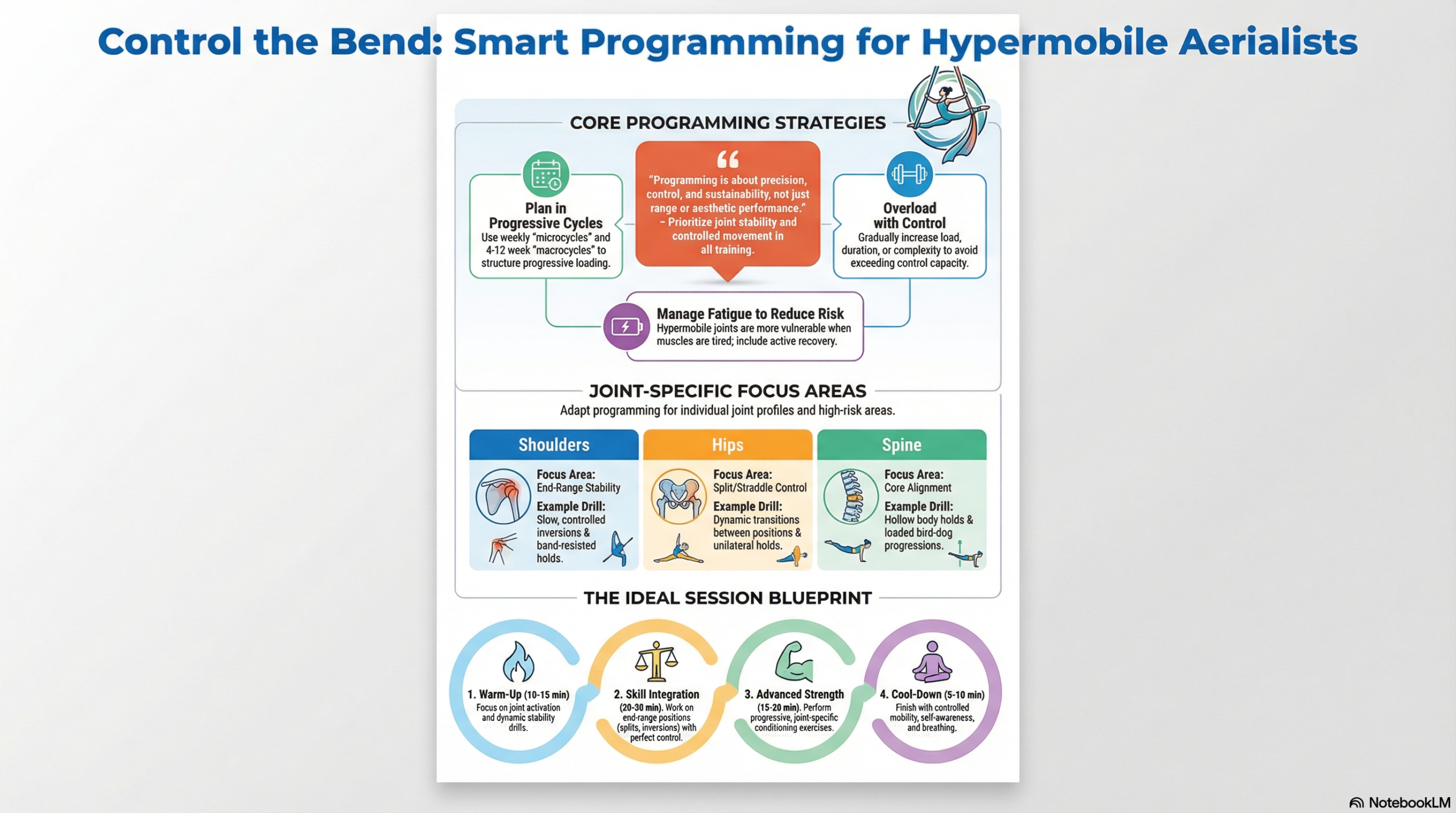
“Advanced programming is about precision, control, and sustainability, not just range or aesthetic performance.”
Section 2 — Programming Strategies
Key Strategies:
- Microcycle and Macrocycle Planning:
- Microcycle: weekly sessions
- Macrocycle: 4–12 week block focusing on progressive load, skill acquisition, and stabilization
- Progressive Overload for Hypermobile Athletes:
- Gradual increase in range, load, hold duration, or complexity
- Avoid sudden jumps that exceed control capacity
- Skill Integration:
- Combine stabilization drills directly with aerial/pole skills
- Example: glute engagement during split transitions, scapular holds during inversions
- Fatigue Management:
- Hypermobile joints are more vulnerable when muscles are fatigued
- Include active recovery and low-intensity proprioception drills
Section 3 — Individualized Programming
Joint-Specific Adaptations:
|
Joint |
Focus |
Advanced Drills |
Progression Tips |
|
Shoulders |
End-range stability |
Slow inversions, band-resisted holds |
Gradually add load or time under tension |
|
Hips |
Split/straddle control |
Dynamic transitions, unilateral holds |
Increase depth and hold duration |
|
Spine |
Core + alignment |
Hollow body holds, bird-dog progressions with load |
Add rotation/control drills |
|
Wrists |
Grip & integrity |
Finger-tip holds, pole grips with load |
Increase duration, controlled movement |
Reflection:
- Which joints are most at risk?
- How can you modify skill progression for safety?
Section 4 — Integrating Performance Metrics
- Track movement quality, control, and fatigue
- Rate stability vs. mobility for each joint weekly
- Adjust programming based on performance outcomes rather than aesthetics alone
Example Metrics:
|
Metric |
How to Track |
Notes |
|
Split hold stability |
Control, wobble, duration |
Record video for self-assessment |
|
Inversion control |
Shoulder and scapula alignment |
Track fatigue effect |
|
Transition fluidity |
Smoothness of movement |
Adjust microcycles accordingly |
Section 5 — Capstone Session Structure
Session Template:
- Warm-up (10–15 min): joint activation, dynamic stability
- Skill Integration (20–30 min): end-range positions, splits, inversions, transitions
- Advanced Strength/Conditioning (15–20 min): progressive joint-specific exercises
- Cool-down (5–10 min): controlled mobility, self-awareness, breathing
Tip:
“Always integrate control-based challenges that mimic real skill demands, gradually increasing complexity and load.”