
📌 Module 6 — Aerial-Specific Adaptations

📌 Module 6 — Injury Prevention, Recovery & Longevity
Goal: Equip hypermobile aerial and pole athletes with strategies to prevent injury, recover effectively, and train sustainably for long-term performance.
Module 6 Learning Objectives
By the end of this module, learners will be able to:
- Identify common injuries and risk factors in hypermobile aerial and pole athletes
- Implement prehab and recovery strategies to protect joints and connective tissue
- Integrate mobility, stability, and strength maintenance for longevity
- Apply self-monitoring tools to detect fatigue and prevent overuse
- Develop a long-term sustainable training plan
Section 1 — Understanding Common Injuries
Overview:
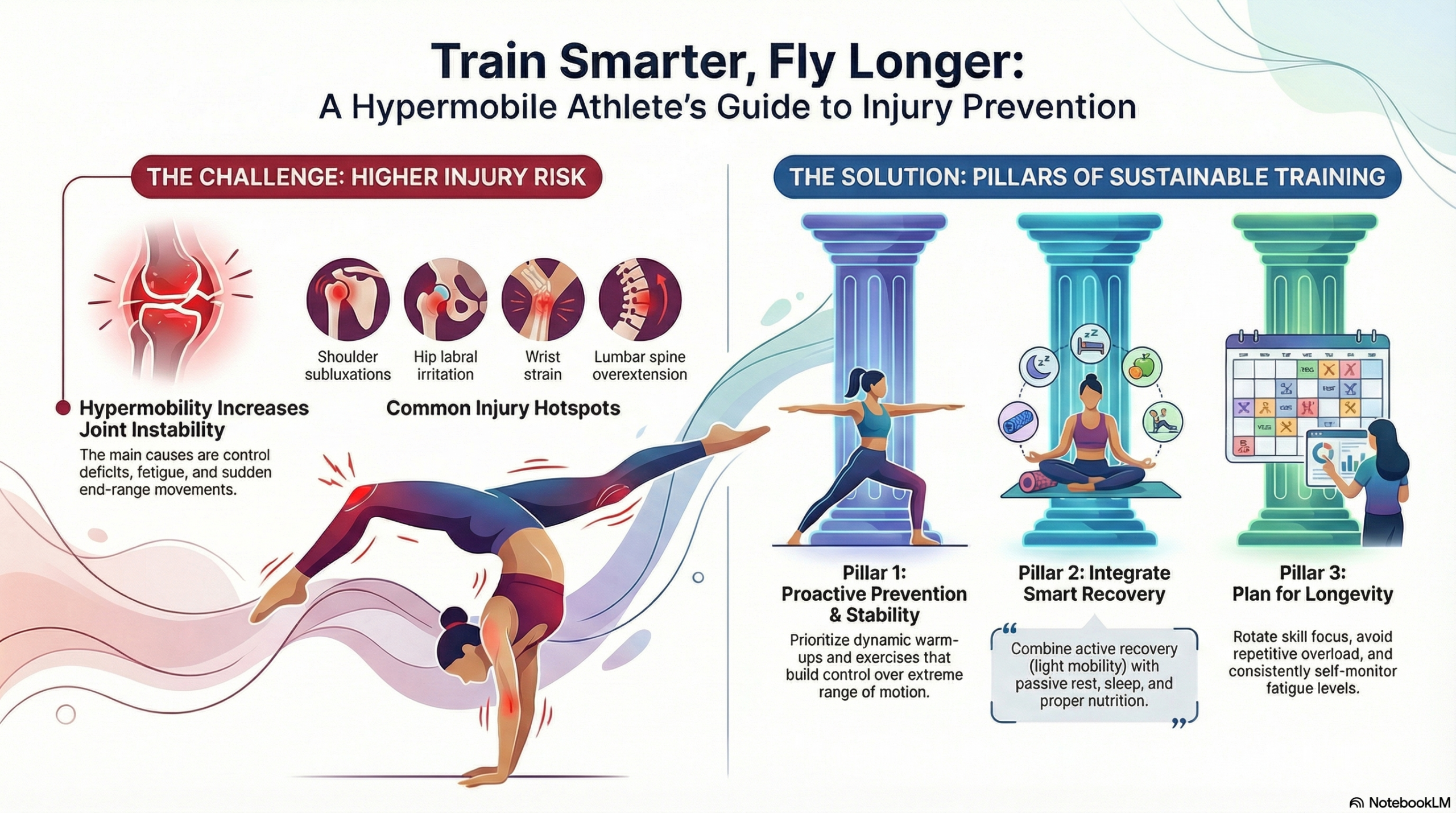
- Hypermobile athletes are more prone to:
- Shoulder subluxation/dislocation
- Hip labral irritation
- Wrist or elbow strain
- Lumbar spine overextension
- Primary cause: control deficits, fatigue, or sudden end-range loading
Key Concept:
“Most injuries are preventable by addressing muscle strength, joint stability, and movement quality before fatigue sets in.”
Section 2 — Prehab & Preventative Strategies
Key Strategies:
- Dynamic Warm-Ups:
- Shoulder and scapular activation
- Hip glute and core activation
- Wrist mobility and forearm strength drills
- Stability & Strength Maintenance:
- Regularly integrate joint-specific exercises (scapular push-ups, glute bridges, plank variations)
- Prioritize control over range during skill practice
- Proprioception & Neuromuscular Control:
- Eyes-closed holds
- Balance and transition drills
- Fatigue-based repetition for real-world skill replication
Section 3 — Recovery Strategies
Components of Recovery:
- Active Recovery: light mobility work, gentle inversions, slow splits
- Passive Recovery: rest days, foam rolling, self-massage
- Sleep & Nutrition: adequate protein, hydration, anti-inflammatory foods
- Tracking: monitor soreness, range of motion, joint control
Tip:
“Recovery is training too. Overlooking it increases injury risk exponentially in hypermobile athletes.”
Section 4 — Longevity Planning
Long-Term Principles:
- Avoid repetitive end-range overload
- Maintain strength and control consistently
- Rotate skill focus to reduce joint stress
- Regularly reassess joint control and fatigue thresholds
Example:
- Week 1–4: Focus on stabilization and skill practice at low fatigue
- Week 5–8: Progress skill complexity and integrate moderate load
- Week 9–12: Integrate longer sessions with high control but monitor closely
Section 5 — Self-Monitoring & Red Flags
Tools & Techniques:
- Pain vs. normal fatigue awareness
- Movement breakdown monitoring
- Logging sessions for joint-specific fatigue
- Knowing when to reduce load or seek professional input