
📌 Module 9 — Coaching & Communication

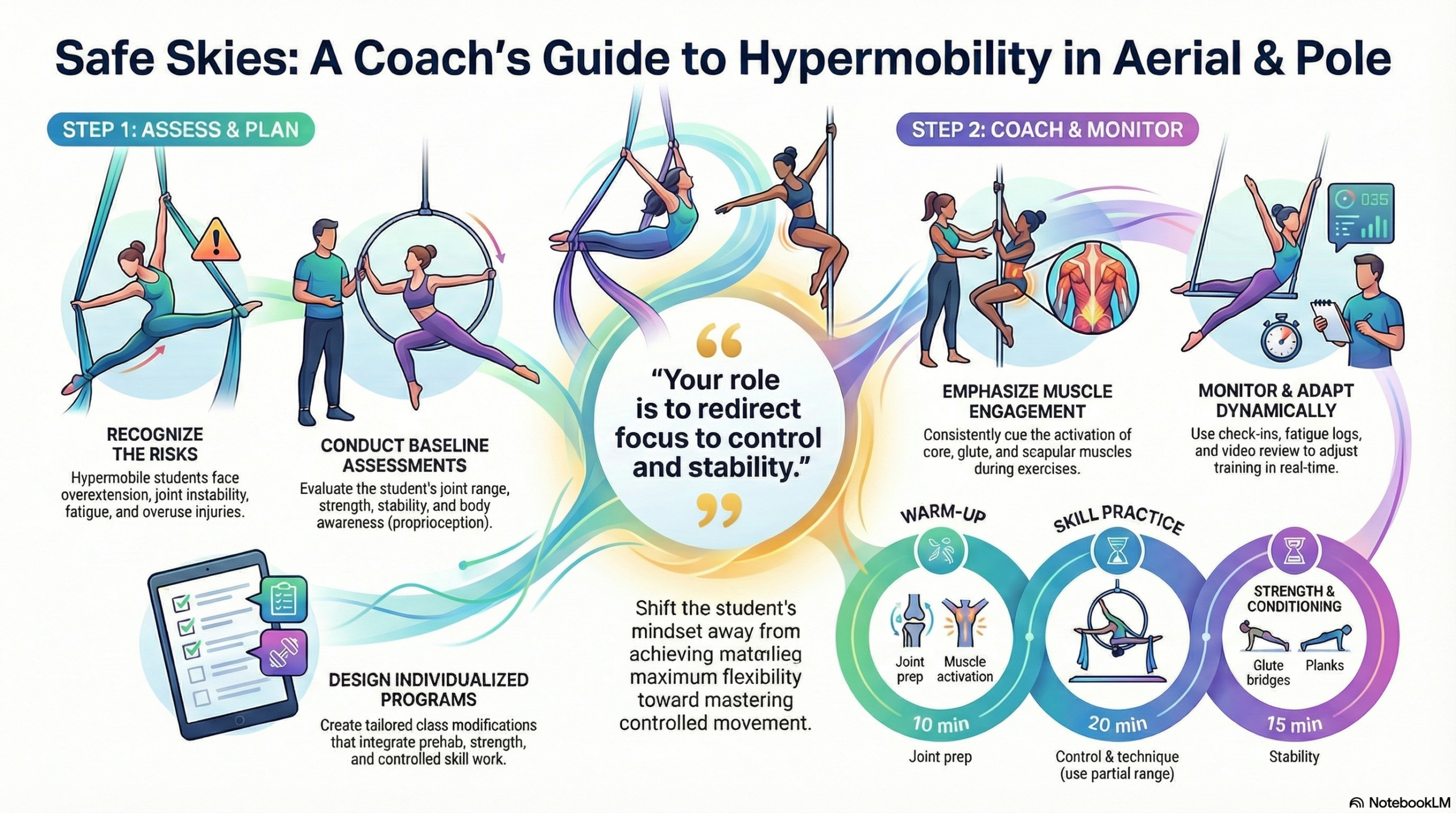
📌 Module 9 — Teaching & Coaching Hypermobility in Aerial & Pole Fitness
Goal: Prepare learners to safely and effectively teach hypermobile students, creating individualized programs, and maintaining joint health while building skill.
Module 9 Learning Objectives
By the end of this module, learners will be able to:
- Assess hypermobile clients safely and identify risks
- Design individualized teaching strategies for aerial and pole students
- Integrate prehab, strength, stability, and skill work into classes
- Communicate effectively about control, safety, and progression
- Monitor student fatigue, technique, and joint control for injury prevention
Section 1 — Understanding Your Hypermobile Students
Key Points:
- Hypermobile clients may have:
- Excessive range of motion
- Reduced joint stability
- Increased fatigue or proprioceptive deficits
- Risks: overextension, subluxation, overuse injuries
- Teaching focus: control over range, gradual progression, and safety cues
Activity: Observation checklist
|
Student |
Joint Laxity |
Fatigue Patterns |
Control Deficits |
Notes |
Section 2 — Assessment & Individualized Programming
Steps for Coaches:
- Conduct baseline assessments: joint range, strength, stability, proprioception
- Identify weak points and at-risk areas
- Create tailored class modifications
- Integrate prehab, strength, and mobility exercises into class warm-ups and conditioning
Example Class Structure:
|
Segment |
Duration |
Exercise / Activity |
Focus |
Modification Tips |
|
Warm-up |
10 min |
Shoulder & hip activation |
Joint prep |
Reduce ROM if needed |
|
Skill Practice |
20 min |
Pole/inversion drills |
Control & technique |
Use support / partial range |
|
Strength & Conditioning |
15 min |
Glute bridges, plank variations |
Stability |
Adjust reps or load |
|
Cool-down |
5 min |
Stretching, recovery |
Mobility & relaxation |
Monitor discomfort |
Section 3 — Teaching Strategies
Key Teaching Principles:
- Emphasize control before range
- Cue muscle engagement (core, glutes, scapula) consistently
- Gradual skill progression: partial → controlled → full range
- Use visual demonstrations and tactile feedback carefully
- Adjust exercises in real-time based on fatigue or technique
Tip:
“Hypermobile students often think ‘more flexibility = better performance.’ Your role is to redirect focus to control and stability.”
Section 4 — Monitoring & Feedback
Tools for Coaches:
- Daily / weekly student check-ins
- Joint stability scoring
- Fatigue and soreness logs
- Video review for technique
- Adjust class content dynamically based on student needs
Reflection Prompts for Coaches:
- Which students need modified exercises today?
- Which skills are causing instability?
- How can you reinforce control cues effectively?
Section 5 — Long-Term Student Development
- Focus on safe skill progression and retention
- Integrate prehab and strength routines consistently
- Rotate skill focus to avoid overuse
- Encourage self-monitoring and awareness among students
Example 4-Week Program for Hypermobile Student:
|
Week |
Skill Focus |
Strength & Stability |
Prehab / Recovery |
Notes |
|
1 |
Controlled inversions |
Glute/shoulder exercises |
Daily joint prep |
Observe fatigue |
|
2 |
Partial splits & transitions |
Core stability |
Prehab integration |
Gradually increase ROM |
|
3 |
Full transitions under control |
Unilateral strength |
Recovery routines |
Adjust based on fatigue |
|
4 |
Flow sequences & combos |
Combined conditioning |
Deload / recovery |
Reinforce control cues |