
📌 Module — Troubleshooting Common Challenges

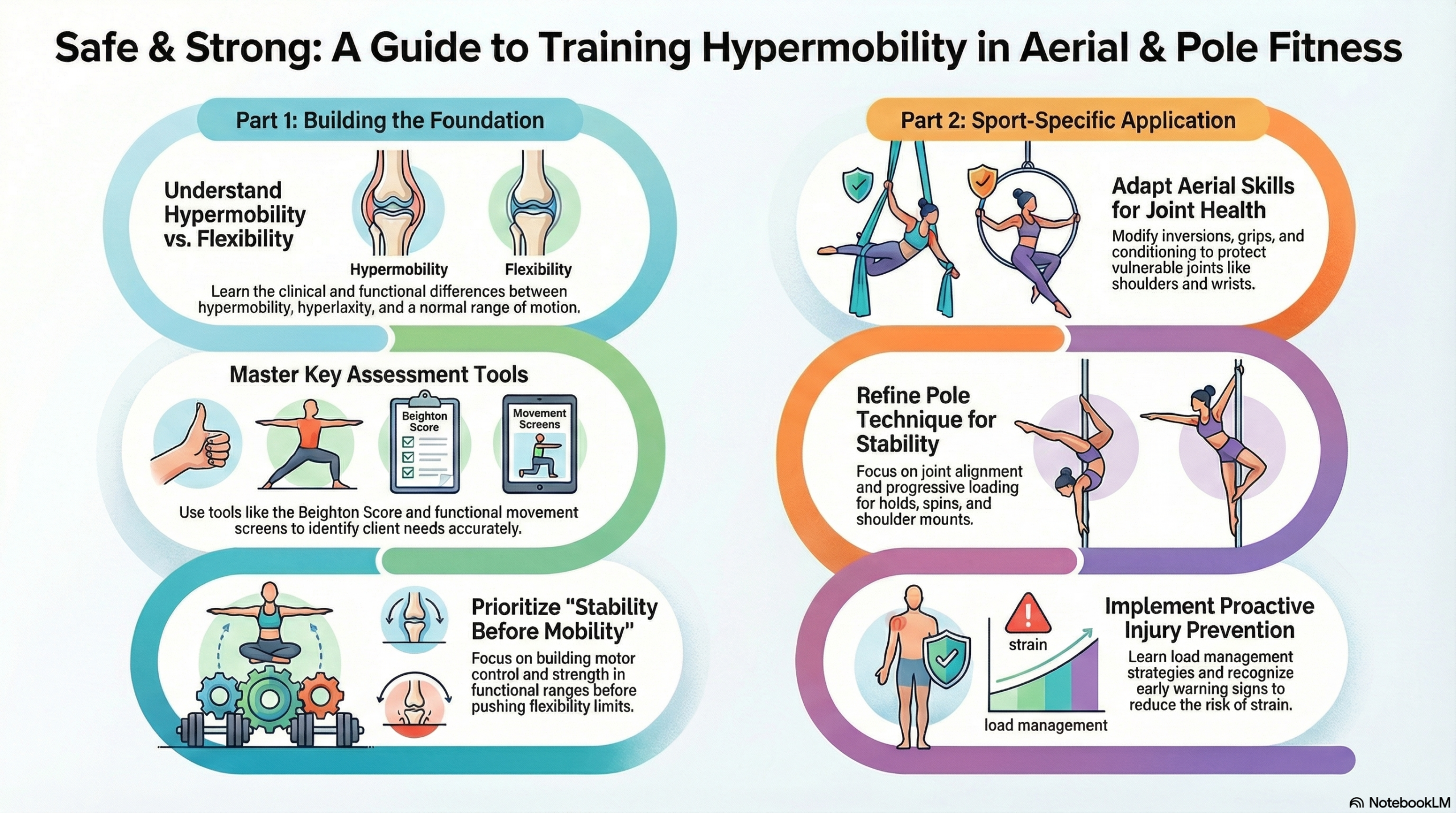
📌 Module — Troubleshooting Common Challenges in Hypermobile Aerial & Pole Fitness
Goal: Equip instructors and students with step-by-step strategies to identify, prevent, and correct common hypermobility-related issues during aerial and pole training.
Module Learning Objectives
By the end of this module, learners will be able to:
- Identify common hypermobility-related issues in aerial and pole fitness
- Apply practical troubleshooting strategies to prevent injuries
- Implement modifications and exercise alternatives for hypermobile students
- Recognize fatigue and instability as risk factors
- Integrate troubleshooting into programming and teaching practice
Section 1 — Shoulder Dislocations
Common Causes:
- Weak rotator cuff and scapular stabilizers
- Overextension during inversions or transitions
- Poor warm-up or fatigue
Troubleshooting Steps:
- Stop the movement immediately if instability occurs
- Support the shoulder and guide it to a safe position
- Strengthen rotator cuff and scapular stabilizers with exercises like:
- External rotations with resistance bands
- Scapular push-ups
- Wall slides
- Modify exercises: partial inversions, use of aerial support, reduce load
- Monitor fatigue and limit consecutive repetitions
Exercise Alternatives:
- Seated or supported inversions
- Isometric shoulder holds before progressing to dynamic moves
Section 2 — Wrist Instability
Common Causes:
- Excessive wrist extension under load (pole grips, silks)
- Weak wrist stabilizers and forearm muscles
- Poor alignment during weight-bearing exercises
Troubleshooting Steps:
- Assess wrist mobility vs. stability
- Introduce wrist-strengthening exercises:
- Wrist curls and extensions
- Forearm pronation/supination with light weights
- Grip-strength drills
- Use wrist supports or padding if needed
- Cue proper alignment: keep wrists neutral during exercises
Exercise Alternatives:
- Use fists instead of open palms on pole
- Modify silks grips with loops or handles
- Floor-based practice before progression to aerial weight-bearing
Section 3 — Lower Back Hyperextension
Common Causes:
- Hypermobile lumbar spine
- Weak core and glute stabilizers
- Overarching during tricks or transitions
Troubleshooting Steps:
- Stop movement if hyperextension or discomfort occurs
- Cue neutral spine and core engagement
- Strengthen core and glutes:
- Planks and side planks
- Dead bugs
- Glute bridges
- Modify exercises: reduce arch, partial transitions, avoid end-range stress
- Progress gradually as control improves
Exercise Alternatives:
- Controlled partial backbends before full trick
- Floor-based drills focusing on spinal alignment
- Use props like mats or blocks for support
Section 4 — Fatigue Affecting Form
Common Causes:
- Overtraining or insufficient recovery
- Inadequate warm-up
- Poor proprioception in hypermobile joints
Troubleshooting Steps:
- Monitor student fatigue with check-ins
- Adjust exercises: reduce reps, partial range, or use assisted moves
- Incorporate rest and recovery strategically
- Encourage students to track their own fatigue and joint control
- Integrate prehab, mobility, and conditioning to maintain form
Exercise Alternatives:
- Substitute high-load moves with low-load stability drills
- Focus on technique over intensity during fatigued sessions
- Shorter circuits with more breaks
Section 5 — Summary Troubleshooting Table
|
Issue |
Common Cause |
Step-by-Step Solution |
Modifications / Alternatives |
|
Shoulder dislocation |
Weak rotator cuff, overextension |
Stop, support, strengthen, modify load |
Partial inversions, supported holds |
|
Wrist instability |
Overextension, weak stabilizers |
Strengthen wrists, cue alignment, use support |
Fist grip, loops, floor prep |
|
Lower back hyperextension |
Weak core/glutes, hypermobile spine |
Cue neutral spine, strengthen core/glutes, modify |
Partial backbends, mats |
|
Fatigue affecting form |
Overtraining, poor proprioception |
Monitor fatigue, reduce load, rest, prehab |
Low-load stability, technique focus, assisted moves |