
What Makes Bungee Fitness Unique?
What Makes Bungee Fitness Unique?
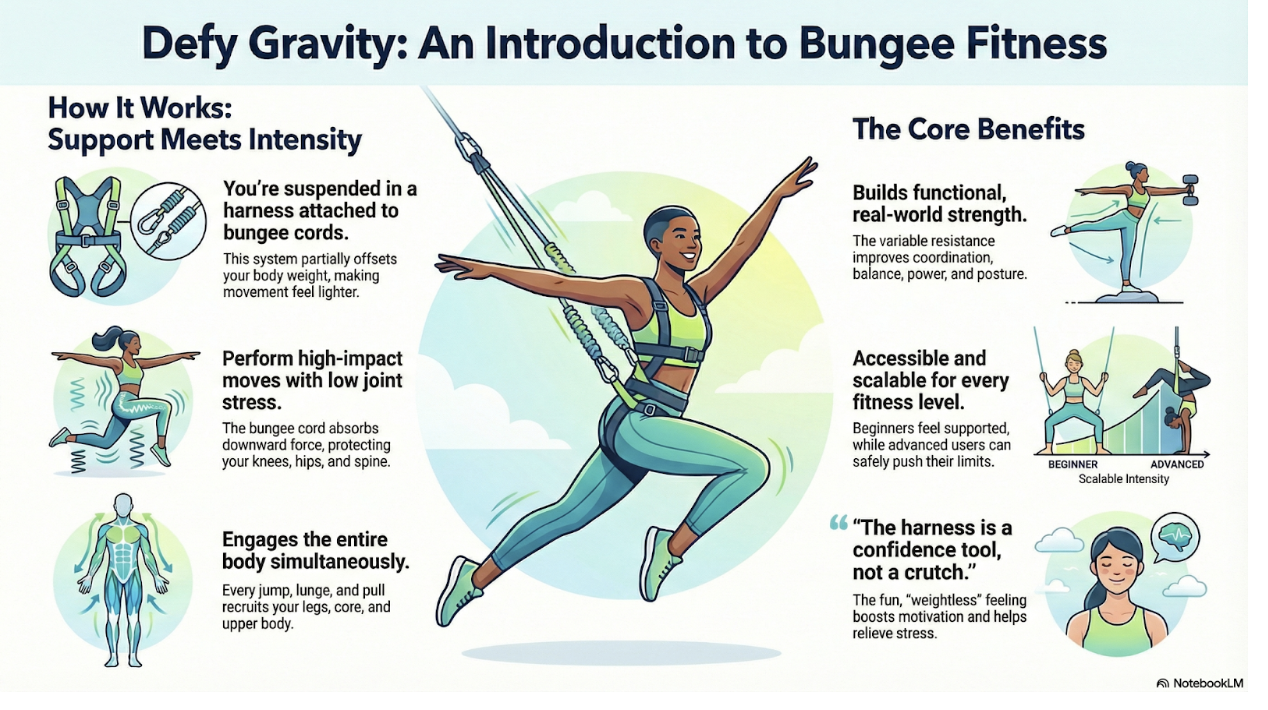
Bungee fitness isn’t just “exercise with a cord.” It’s a multi-dimensional, functional training method:
- Suspension & Support: Participants wear a harness attached to elastic cords. This partially offsets body weight, which allows:
- High-impact movements like jumps and tucks without stressing joints
- Beginners to perform moves they might not otherwise attempt
- Advanced participants to push limits safely
- Full-Body Engagement: Every movement recruits multiple muscle groups simultaneously:
- Legs: quads, glutes, hamstrings, calves
- Core: abdominals, obliques, spinal stabilizers
- Upper body: shoulders, back, arms (especially during balance, pulls, or aerial crossover moves)
- Dynamic Functional Movement: Exercises aren’t isolated; they mimic real-world movement patterns: squatting, lunging, jumping, pushing, pulling, rotating. This improves coordination, balance, and proprioception.
The Science Behind It
- Low-Impact Cardio: The cord reduces downward force when jumping, protecting knees, hips, and spine.
- Elastic Resistance: Bungee cords create variable resistance – the further you stretch, the more tension you work against. This boosts strength, power, and endurance simultaneously.
- Core & Glute Focus: Almost every movement requires core stabilization and glute activation for balance and control. Over time, participants develop functional strength and posture improvements.
Expert Insight: Even small jumps or assisted tucks recruit stabilizer muscles that are often neglected in traditional gyms. That’s why bungee is a hidden powerhouse for full-body conditioning.
Why It’s Accessible to All Levels
Bungee fitness scales naturally:
- Beginners: Supported by the harness, they can perform dynamic movements with confidence, learning proper alignment, joint safety, and muscle engagement.
- Intermediate: Can increase speed, range of motion, or resistance in exercises to challenge strength and coordination.
- Advanced: Can add complex combinations, aerial crossover moves, or plyometric sequences, all while the cord provides a safety net for experimentation.
Expert Tip: The harness is a confidence tool, not a crutch. It lets participants explore their limits safely and encourages instructors to teach with creativity and energy.
Mental & Emotional Benefits
- Confidence: Feeling “weightless” while suspended makes participants more willing to try new moves or push past fear.
- Motivation: The novelty and fun factor keep people coming back – especially compared to repetitive traditional workouts.
- Stress Relief: Jumping, moving dynamically, and engaging fully with the cord releases tension and increases endorphins.
Practical Teaching Insight for Instructors
- Cueing Muscles & Joints: Teach participants which muscles to engage in every move (e.g., squeeze glutes on landing, brace core during jumps).
- Alignment Matters: Watch knees, spine, and shoulder positioning – even small misalignments can affect stability.
- Modify for Safety: Encourage variations based on ability or injuries; the harness allows a wide range of adaptations.
- Energy Transfer: Participants feed off instructor enthusiasm – the visual “bounce” of the cord adds a playful, high-energy dynamic to the room.
Key Takeaways
- Full-body + low-impact: Achieve strength, cardio, and core engagement safely.
- Scalable & accessible: Works for beginners to advanced without changing equipment.
- Functional & fun: Trains movement patterns, stability, and confidence.
- Support + freedom: The harness keeps participants safe while encouraging dynamic movement.
- Instructor advantage: Allows you to focus on teaching, cueing, and motivating rather than constantly spotting for safety.