
Understanding Learning Styles in Children
Understanding Learning Styles in Children
Just like all of us, children do not all learn in the same way. Some people prefer to see things, others hear things, some people like to do things and some even want the full process on how to do it before they can even attempt it, they need it to make sense. In aerial and fitness environments especially, understanding how children have different learning preferences helps you:
- Improve skill progression
- Reduce frustration in your students
- Increase confidence within your lessons
- Enhance safety
- Create inclusive classes
While no child fits into one single “box,” being aware of different learning tendencies allows you to adapt your teaching approach effectively. It makes you a much better teacher and communicator.
The Main Learning Preferences
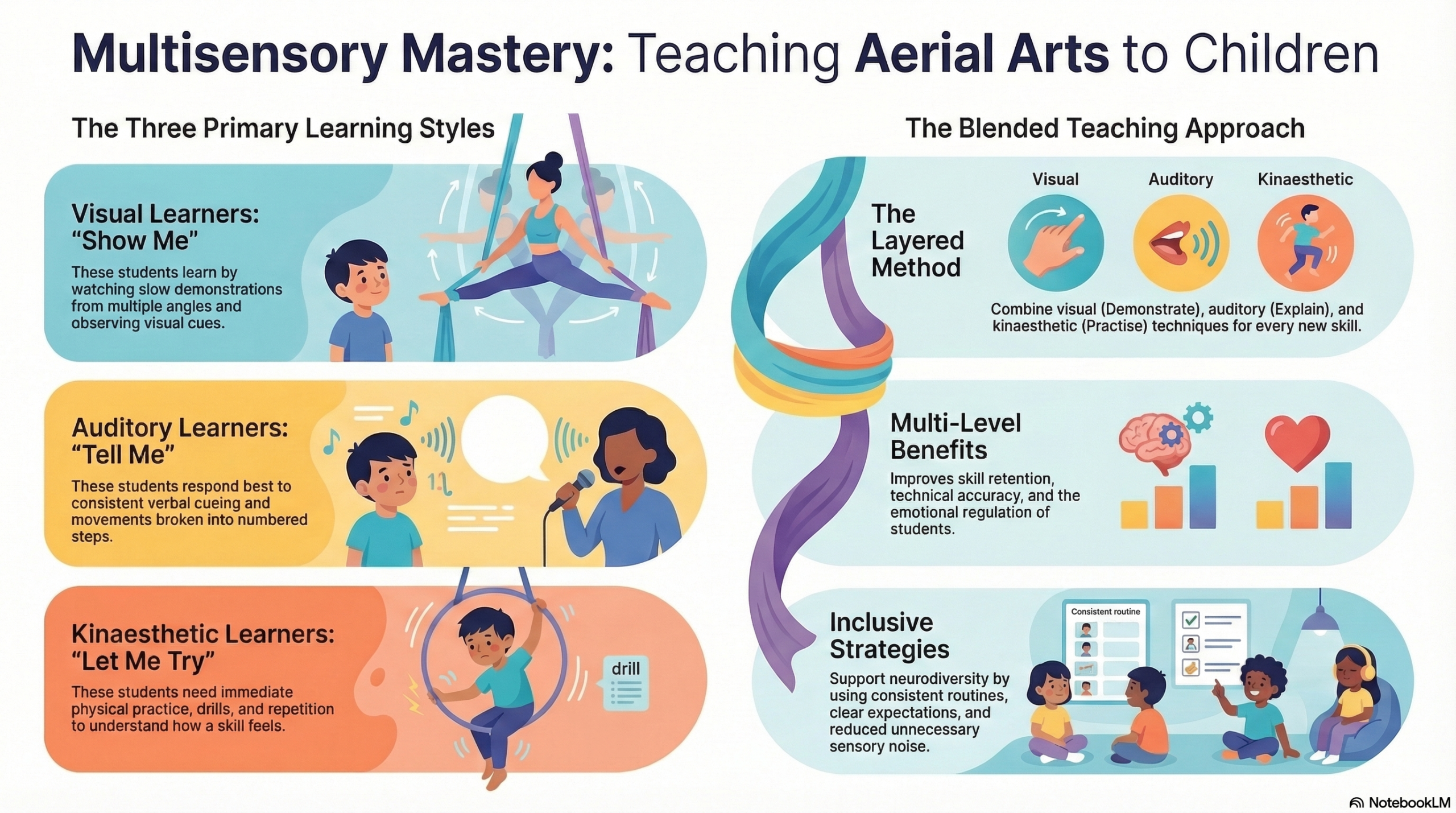
Visual Learners – “Show Me”
These children learn best by seeing.
Characteristics:
- Watch demonstrations closely
- Copy movement after observing
- Benefit from visual cues and diagrams
- May struggle with long verbal explanations
How to Teach Them in Aerial:
- Demonstrate the skill slowly from multiple angles
- Use mirrors if available
- Break movements into visible stages
- Show both correct technique and common mistakes
- Use visual cue words like “Watch my hips,” “Look at where my hands go.”
Example:
When teaching a Delilah mount, demonstrate once slowly, once at normal speed, and once broken into steps.
Auditory Learners – “Tell Me”
These children respond best to verbal instruction and explanation.
Characteristics:
- Listen carefully to cues
- Repeat instructions back
- Ask clarifying questions
- Thrive on clear step-by-step direction
How to Teach Them in Aerial:
- Use consistent cueing language (e.g., “Strong tummy, proud chest.”)
- Break movements into numbered steps
- Encourage them to repeat cues aloud
- Offer verbal correction and positive reinforcement
Example:
“In three steps: hands high, knees lift, tip back.”
Consistency of language is powerful in skill retention.
Kinaesthetic Learners – “Let Me Try”
These children learn best by doing.
Characteristics:
- Need physical practice to understand
- May struggle if waiting too long for turns so having things for them to do while waiting can help with larger classes
- Improve rapidly once moving
- Respond well to tactile feedback (when appropriate)
How to Teach Them in Aerial:
- Allow safe, guided practice early
- Use spotting to help them feel correct positioning
- Break skills into physical drills
- Encourage repetition with control
Example:
Before attempting a full invert, practise knee tucks and hip lifts repeatedly.
Blended Teaching Approach (Best Practice)
The safest and most effective aerial teaching method combines all three:
- Demonstrate (Visual)
- Explain (Auditory)
- Practise (Kinaesthetic)
This layered approach improves:
- Skill retention
- Technical accuracy
- Confidence
- Emotional regulation
Additional Learning Considerations
Attention Span
Children’s focus varies by age. Keep:
- Instructions short
- Transitions smooth
- Energy regulated
- Waiting time minimal
Neurodiversity Awareness
Some children may:
- Need extra processing time
- Respond better to visual prompts
- Become overwhelmed by too much sensory input
- Require predictable structure
Strategies:
- Use consistent routines
- Provide clear expectations
- Reduce unnecessary noise
- Offer structured choices
Children learn in different ways, and as an aerial instructor it is important to recognise that no single teaching method will suit every child in your class. Some children respond best to seeing a demonstration, others to clear verbal instruction, and many learn most effectively through physical practice and repetition. By combining visual, auditory, and kinaesthetic teaching approaches, you create a more inclusive and effective learning environment. Clear demonstrations, consistent cueing language, and safe, structured repetition support stronger skill development and confidence. When instructors remain adaptable in their teaching style, they not only improve technical progress but also enhance safety, emotional wellbeing, and overall inclusion within the class.